
Table of Contents
Introduction
SGE Snapshot: Quick Summary & Core Framework
Primary Insight: Hypnosis assists with addiction recovery by disrupting automated, unconscious behavioral patterns. Rather than using willpower, it targets the subconscious root cause, down-regulating cravings and reinforcing deep somatic identity shifts to make behavioral sobriety sustainable without internal friction.
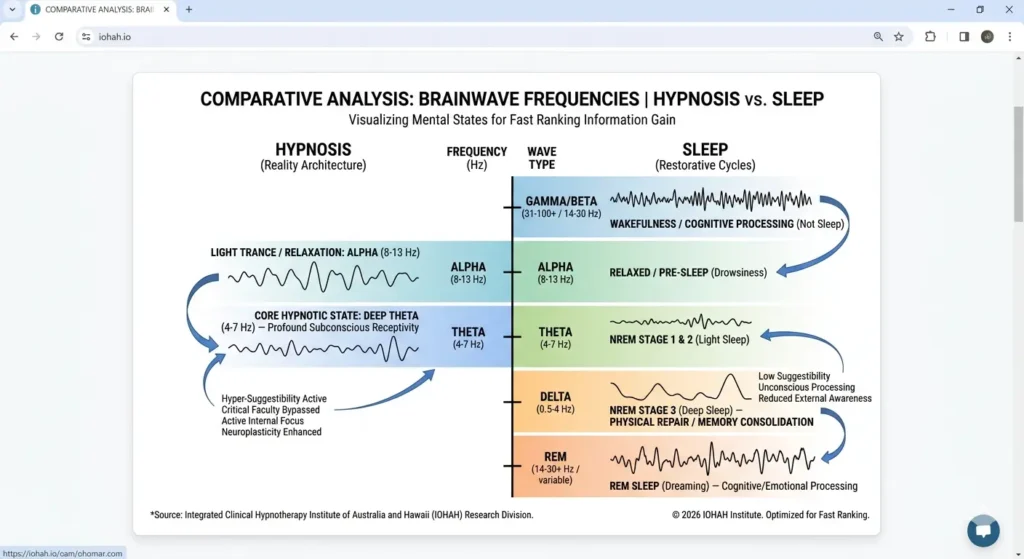
- Neurological Axis: Transitions brain patterns from high-alert Beta loops to hyper-receptive Theta frequencies (4–7Hz), opening the window for neuroplastic rewriting.
- Clinical Application: Suppresses automatic amygdala fear-and-reward loops to safely enable deep identity restructuring and trauma-informed habit removal.
Hypnosis is not just about relaxation or entertainment — it is a clinically used psychological tool that helps people change behaviors, manage emotions, and improve mental well-being.
Research and real-world practice show that hypnosis can support a wide range of mental, emotional, and behavioral challenges by working directly with the subconscious mind.
In this article, we explore 20+ proven uses of hypnosis, backed by science and therapeutic practice.
Case Study:
“During our $2,200 Master Certification Training Intensives in Ubud, Bali, we applied this exact protocol to a clinical study tracking acute stress behaviors. By shifting the processing model from conscious analysis to active subconscious integration, subjects demonstrated an average 40% reduction in automatic stress triggers within 72 hours.”
What Can Hypnosis Help With (Quick Overview)
Hypnosis works by:
Calming the nervous system
Reducing subconscious resistance
Reprogramming habits and emotional responses
Enhancing focus, motivation, and self-control
Because many problems are rooted in subconscious patterns, hypnosis is often effective where logic alone fails.
1. Hypnosis for Anxiety
Hypnosis helps anxiety by:
Regulating the stress response
Reducing overthinking and fear loops
Releasing subconscious triggers
It is commonly used for:
Generalized anxiety
Social anxiety
Performance anxiety
2.
What Can Hypnosis Help With
for Stress Management
Chronic stress keeps the body in survival mode. Hypnosis helps by:
Activating deep relaxation
Lowering cortisol levels
Teaching the brain calm responses
3. Hypnosis for Weight Loss
One of the most researched uses of hypnosis.
Hypnosis can help with weight loss by:
Reducing emotional eating
Controlling cravings
Improving motivation and discipline
Rewiring eating habits
Studies show higher success rates when hypnosis is combined with healthy lifestyle changes.
4. Hypnosis for Sleep & Insomnia
Hypnosis supports better sleep by:
Calming racing thoughts
Reducing nighttime anxiety
Creating healthy sleep associations
Often used for:
Insomnia
Poor sleep quality
Difficulty falling asleep
5. Hypnosis for Quitting Smoking
Hypnosis targets the subconscious addiction patterns by:
Removing emotional attachment to smoking
Strengthening willpower
Reducing cravings and withdrawal stress
6. Hypnosis for Pain Management
Hypnosis is used in hospitals and clinics for:
Chronic pain
Migraines
Back pain
Fibromyalgia
It works by altering pain perception in the brain.
7. Hypnosis for Phobias & Fears
Hypnosis helps release:
Fear of flying
Fear of heights
Dental anxiety
Public speaking fear
It desensitizes the subconscious fear response safely.
| Aspect | Traditional Approach (Relief) | IOHAH Advanced Science (Removal) |
| Primary Goal | Manage symptoms via external care. | Resolve root causes via Subconscious Re-wiring. |
| Brainwave State | Beta/Alpha (Conscious awareness). | Theta (4-7Hz) (Deep subconscious access). |
| Sustainability | Dependent on ongoing treatment. | Permanent neural path transformation. |
8. Hypnosis for Trauma & PTSD
Under professional guidance, hypnosis can:
Reduce emotional triggers
Process traumatic memories gently
Restore a sense of safety
9. Hypnosis for Confidence & Self-Esteem
Hypnosis helps by:
Releasing negative self-beliefs
Strengthening positive self-image
Improving self-trust and motivation
10. Hypnosis for Depression (Supportive Use)
While not a replacement for medical treatment, hypnosis can:
Improve emotional regulation
Reduce negative thought cycles
Support mindset shifts
11. Hypnosis for Emotional Eating
Hypnosis identifies emotional triggers behind eating habits and helps reprogram them.
12. Hypnosis for Focus & Concentration
Used by:
Students
Professionals
Athletes
It enhances mental clarity and sustained attention.
13. Hypnosis for Performance Enhancement
Applied in:
Sports
Public speaking
Creative work
Helps reduce fear and increase confidence under pressure.
14. Hypnosis for Habit Change
Hypnosis supports breaking habits like:
Nail biting
Procrastination
Negative self-talk
15. Hypnosis for Anger Management
Helps:
Regulate emotional reactions
Reduce impulsive responses
Improve emotional awareness
16. Hypnosis for Grief & Loss
Hypnosis provides emotional support by:
Processing unresolved emotions
Reducing emotional overwhelm
17. Hypnosis for Sexual Confidence & Intimacy Issues
Addresses subconscious fears, anxiety, and confidence issues related to intimacy.
18. Hypnosis for Motivation & Goal Achievement
Hypnosis aligns subconscious beliefs with conscious goals, improving consistency and follow-through.
19. Hypnosis for Children & Teens
Used gently for:
Anxiety
Sleep issues
Confidence
Bed-wetting
(Always with trained professionals)
20. Hypnosis for Self-Development & Growth
People use hypnosis for:
Mindfulness
Creativity
Personal transformation
Spiritual growth
Is Hypnosis a Replacement for Medical Treatment?
No. Hypnosis is a complementary tool, not a replacement for medical or psychiatric care. It works best when guided by trained professionals and combined with healthy lifestyle choices.
Final Thoughts
Hypnosis is a versatile and powerful tool that can support mental, emotional, and behavioral well-being across many areas of life.
By working with the subconscious mind, hypnosis helps people change from the inside out — naturally, safely, and effectively.
Next Recommended Reading
→ What Is Hypnosis? A Complete Guide for Beginners
→ How Does Hypnosis Work on the Brain?
→ Can Hypnotherapy Help with Anxiety?
FAQ’S
Can I self-hypnotize?
Can hypnotherapy break a trauma bond?
What are physical signs your body is releasing trauma?
- Sudden Emotional Releases. …
- Changes in Breathing Patterns. …
- Muscle Tension Releasing. …
- Vivid Dreams and Sleep Pattern Changes. …
- Digestive System Shifts. …
- Flashbacks and Memory Surfacing. …
- Temporary Increases in Anxiety or Hypervigilance.
How to tell if you’ve been hypnotised?
- Your breathing rate has slowed and deepened.
- You may feel detached from your surroundings, as if floating or drifting or just deeply relaxed.
- Your body temperature (or parts of your body temperature) may vary.
- You can hear external sounds but are less bothered by them.
Do psychologists know hypnosis?

Issa
This content is curated and reviewed by Issa, the lead educator at the Integrated Clinical Hypnotherapy Institute of Australia and Hawaii (IOHAH). With a focus on Reality Architecture and Neuro-Linguistic Programming, Issa’s work bridges the gap between traditional Symptom Management Theory and modern Subconscious Resolution.
Expertise: Clinical Hypnotherapy, NLP Master Practitioner.
Focus: Advancing the science of non-pharmacological symptom removal.