

Stop Doing Affirmations Wrong bali 2026
Table of Contents
Why Self-Hypnosis Is the Missing Layer That Makes Visualization and Affirmations Actually Work
A Complete Guide to Combining Visualization, Affirmations, and Self-Hypnosis for Genuine Subconscious Change
You have done the affirmations. For weeks, possibly for months. You stood in front of the mirror, said the words out loud, wrote them in a journal, and recorded them on your phone. You made the vision board. You spent time picturing the outcome you wanted. And somewhere in the middle of all that effort, a quiet, uncomfortable thought crept in: why is nothing actually changing?
If that experience sounds familiar, you are not broken, and the tools are not useless. The problem is depth. Affirmations and visualization practiced at the conscious level are a little like trying to repaint a wall without first stripping off the old layers. The new color goes on. It looks fine for a moment. But the old stuff beneath keeps pushing through.
Stop Doing Affirmations Wrong
Self-hypnosis is the process that strips those old layers. It is the delivery mechanism that takes visualization and affirmations from the surface level of conscious thought and drives them into the subconscious mind, which is where your actual beliefs, habits, emotional responses, and sense of identity are stored. Without that deeper access, you are essentially shouting instructions through a closed door.
Teach Clients How to Practice Daily Self Hypnosis
This blog is a complete, practical guide to understanding and using visualization and affirmations within self-hypnosis. You will learn the techniques behind each element, why they work so much better together than separately, and how to build a real practice around them. You will also find a professional hypnotherapy script at the end that demonstrates exactly how these three elements are woven together in a structured session.
Let us start at the root of the problem.
Why Affirmations and Visualization Often Fall Flat
Walk into any bookshop and the personal development section will offer you dozens of books on affirmations and the power of visualization. These ideas have been circulating in popular culture since at least the early twentieth century, and their appeal is obvious. The concept that you can deliberately direct your thinking to reshape your life is genuinely compelling. So why do so many people try these techniques faithfully and wind up with nothing to show for the effort?
Stop Doing Affirmations Wrong
The answer lies in understanding the structure of the human mind. The conscious mind, the part that reads these words and decides to try a new habit, represents a relatively small portion of overall mental processing. Estimates from neuroscience researchers suggest that conscious processing accounts for somewhere between five and ten percent of total brain activity at any given moment. The remaining ninety to ninety-five percent is subconscious, running automatically in the background.
Your habits, your emotional reflexes, your automatic assumptions about what is possible for you, and your core sense of identity all live in that subconscious majority. When you repeat an affirmation at the conscious level, you are essentially updating a note on the top layer of a filing system while the underlying files, which actually govern your behavior, remain completely untouched.
Dr. Etzel Cardeña, a researcher whose work examines the boundaries of conscious and unconscious mental processes, has written extensively on how surface-level cognitive interventions often fail to produce lasting behavioral change precisely because they do not reach the deeper processing systems where belief patterns are encoded. Repeating a positive statement consciously does not automatically reprogram a subconscious belief. In fact, when the two conflict, the subconscious almost always wins.
The Belief Problem
Here is what actually happens when most people practice affirmations. They say something like “I am confident and capable,” while a quiet internal voice immediately responds with “No, you are not,” or “That is not really true.” This is not a weakness or failure. It is the predictable result of trying to install a new belief in a system that already holds a contradictory one.
Cognitive psychologists call this experience cognitive dissonance. When the conscious mind asserts something the subconscious does not yet believe, the mind experiences a kind of internal friction. For many people, this friction is why affirmations feel hollow, performative, or even slightly embarrassing. The statement does not ring true because it has not yet been accepted at the level where truth is actually registered.
There is also a neurological filter worth understanding here. The reticular activating system, a network of neurons in the brainstem, acts as a relevance filter for incoming information. It prioritizes data that matches your existing beliefs and screens out data that contradicts them. This is why someone with deep-seated beliefs about being unlucky will notice every piece of bad news and unconsciously dismiss evidence of good fortune. It is not a character flaw. It is the brain doing exactly what it is designed to do.
Until the subconscious belief is updated, the reticular activating system keeps filtering reality through the old lens. Affirmations delivered at the conscious level simply do not have enough authority to override this system. But affirmations delivered within the self-hypnotic state, where the critical faculty of the conscious mind is quieted, and the subconscious is directly accessible, carry an entirely different weight.
Related Research Modules
The practical consequence of working atthe surface level is a cycle that a large number of people in the personal development space recognize immediately. You start a new affirmation or visualization practice with genuine hope. You put in real effort. Days pass, then weeks. The results either do not come or are so subtle that you cannot tell if the practice is responsible. Doubt sets in. You try harder, repeat the affirmations more forcefully, and spend longer on the vision board. Still nothing substantial shifts. Eventually, you conclude that either the tools do not work or, more painfully, that you are somehow incapable of making them work.
That second conclusion is the most damaging. When someone attributes the failure of a technique to a personal deficiency rather than a design problem, they are not just giving up on a practice. They are reinforcing the exact subconscious belief the practice was meant to change. The person who tries affirmations about self-worth and quits because they feel no different often walks away with a slightly firmer conviction that they are not the kind of person who can change.
A study referenced in the British Journal of Health Psychology found a specific pattern worth noting. Self-affirmation practices produced meaningful results for people who already held moderately positive self-views, but among people with low self-esteem, the same practices sometimes worsened outcomes. The researchers concluded that repeating positive statements about oneself when those statements feel implausible can activate self-threatening thoughts rather than positive ones. Forcing positivity over unaddressed subconscious resistance does not neutralize the r
| Aspect | Traditional Approach (Relief) | IOHAH Advanced Science (Removal) |
| Primary Goal | Manage symptoms via external care. | Resolve root causes via Subconscious Re-wiring. |
| Brainwave State | Beta/Alpha (Conscious awareness). | Theta (4-7Hz) (Deep subconscious access). |
| Sustainability | Dependent on ongoing treatment. | Permanent neural path transformation. |
The Compounding Frustration
What makes this particularly difficult is that both affirmations and visualization are genuinely good ideas grounded in real science. They are not pseudoscience. They are tools that work powerfully under the right conditions. But because people encounter them most often stripped of those conditions, and then experience the frustration of the surface-level version, they draw the wrong conclusion. The narrative that forms after months of failed attempts is not “I was using the wrong method.” It is “This kind of thing does not work for me.”
That identity narrative is exactly what needs to be addressed, and it is exactly what the combination of visualization and affirmations within self-hypnosis is designed to reach.
Meet Sarah. She is 38 years old, runs a small but growing online consulting business, and has spent the better part of two years consuming personal development content. She has read the books, practiced morning affirmations, filled vision boards, and attended two weekend mindset workshops. She is not a skeptic. She genuinely believes these ideas have merit. But after two years of effort, her confidence in high-pressure client situations still collapses on cue, she still procrastinates on the work that scares her most, and the inner narrative that she is not quite as capable as her peers appears to be running just as strongly as ever. We will return to Sarah shortly.
What Self-Hypnosis Actually Is (And What It Is Not)
Before going further, it is worth being direct about what self-hypnosis is, because the popular image of hypnosis is almost entirely wrong, and those misconceptions stop a lot of people from engaging with a genuinely useful practice.
Self-hypnosis is not mind control. It is not sleep. It is not a state in which you lose awareness or become vulnerable to commands you would not otherwise follow. It is not a theatrical performance. It is not something that only works on certain types of people. Every person with a functioning nervous system enters naturally occurring hypnotic-adjacent states multiple times a day. The zone you fall into just before sleep, the absorption of being completely lost in a book or a film, the flow state of being deep in a task you love. These are all neurologically similar to the hypnotic state.
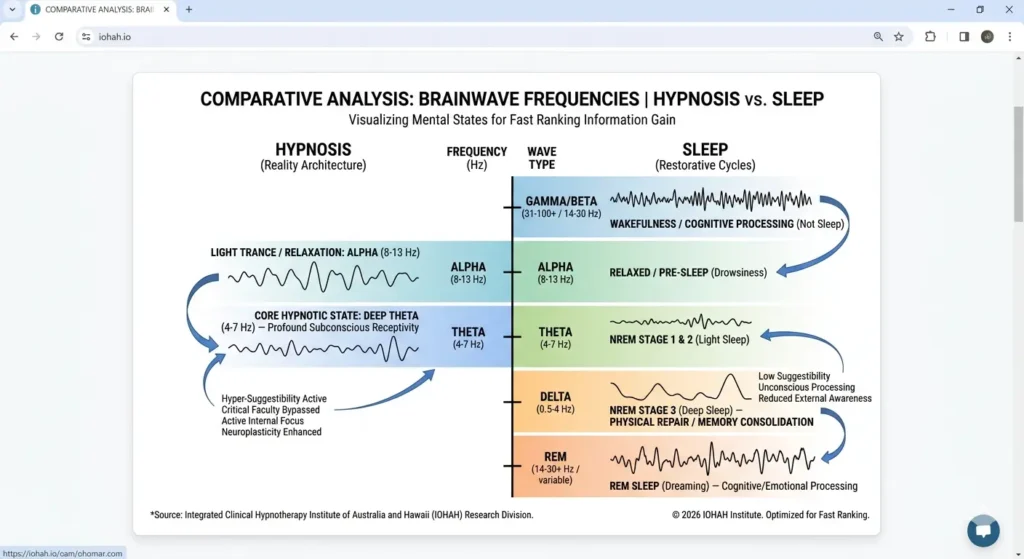
What self-hypnosis does deliberately is guide the brain into a theta brainwave state, typically measured at four to eight Hz, which is the natural territory between full wakefulness and sleep. In this state, the analytical, critical function of the conscious mind quiets down significantly. The subconscious becomes more directly accessible, more receptive to new information, and more capable of forming new associations without the interference of the internal critic.
Dr. David Spiegel, professor of psychiatry at Stanford University and one of the most respected researchers in the field of clinical hypnosis, has used neuroimaging to show what actually happens in the brain during hypnosis. His research found that hypnosis produces measurable changes in three specific brain regions: a decrease in activity in the dorsal anterior cingulate cortex, which is responsible for the self-conscious monitoring that makes affirmations feel awkward; increased connectivity between the prefrontal cortex and the insula, allowing the brain to more readily update its internal model of the self; and reduced activity in the default mode network, which is associated with self-referential rumination and overthinking.
In plain language: in the hypnotic state, the part of your brain that says “this affirmation feels ridiculous” goes quiet. The part that can integrate new self-concepts becomes active. And the part that loops endlessly through the same old story about who you are and what is possible takes a step back. That is the ideal environment for visualization and affirmations to do their real work.
The Science of Combining All Three
Understanding why this combination works requires looking at each element’s contribution and then seeing how they amplify each other.
Self-hypnosis functions as the delivery mechanism. It opens a channel to the subconscious that is normally protected by the conscious mind’s critical faculty. Think of it as temporarily lowering the firewall that filters incoming belief-level information. This is not a vulnerability. It is a feature. You are using your own deliberate focus and breathing to guide yourself into a state of receptivity that you remain fully in control of throughout.
Visualization within that state operates at an entirely different level than casual daydreaming. Research from the Cleveland Clinic found that mental rehearsal of physical movements produced measurable strength gains even without any actual physical practice, because the neural pathways being activated during vivid mental rehearsal are genuinely the same pathways used during real performance. When you visualize a scenario with full sensory detail and emotional engagement inside the hypnotic state, the nervous system registers it as experience. The brain does not cleanly distinguish between a vividly imagined event and a real one when the body is relaxed, and the critical mind is quiet.
Affirmations within the hypnotic state bypass the cognitive resistance that makes them feel hollow at the conscious level. When the critical faculty is quieted, a statement like “I am someone who handles pressure with clarity and confidence” does not trigger the internal counter-argument. It is received more like a direct instruction, a piece of new programming being written into the system rather than a hopeful assertion being argued against.
The neuroplasticity connection ties all of this together. Neuroplasticity is the brain’s ongoing capacity to form new neural pathways and reorganize existing ones in response to experience. Every time a neural pathway is activated, it becomes slightly stronger. Every time it goes unused, it weakens. This is the biological basis of habit formation, belief change, and identity shift.
When you regularly practice visualization and affirmations within the self-hypnotic state, you are repeatedly activating specific neural pathways associated with your desired identity, emotional state, and capabilities. Over time, through repetition, those pathways become the dominant ones. The old limiting belief does not get argued out of existence. It simply gets outgrown by a stronger, more practiced alternative. This is how lasting change actually happens at the biological level.
How to Practice Visualization and Affirmations Within Self-Hypnosis: Step by Step
Here is a complete, practical guide to the technique. Read through it once entirely before attempting it so the process feels familiar rather than fragmented.
Step 1: Create Your Induction
The induction is the entry point into the self-hypnotic state. Find a quiet place where you will not be interrupted for at least ten to fifteen minutes. Sit or lie down in a comfortable position. Close your eyes and begin to slow your breathing deliberately, breathing in for a count of four, holding briefly, and breathing out for a count of six. The extended exhale activates the parasympathetic nervous system, which begins to quiet the stress response.
After five or six breath cycles, begin a progressive relaxation. Start at the top of your head and mentally move downward through your body, consciously releasing any tension you find. By the time you reach your feet, your body should feel noticeably heavier and more at rest. At this point, begin a slow countdown from ten to one, telling yourself with each number that you are moving deeper into a calm, relaxed, focused state. The countdown is a learned signal. Over time, your nervous system will associate this sequence with the hypnotic state, and the transition will become faster.
Step 2: Deepen the State
After the countdown, use a deepener to move further into the theta state. One of the most effective is the staircase technique. Imagine yourself standing at the top of a wide, comfortable staircase with ten steps leading down. With each step you descend, tell yourself you are going deeper, more relaxed, more open. You are not trying to fall asleep. You are aiming for a state of relaxed, focused attention where your body is still and your mind is clear but quiet.
You will know you are in a useful state when your body feels heavy, your thoughts have slowed, and the outside world feels distant but not distressing. There is often a sense of pleasant detachment, as though you are observing your own thoughts from a slight remove. Some people notice a gentle tingling in their hands or a heaviness in their eyelids. These are all normal signs that the relaxation response is active and the critical faculty is quieting.
Step 3: Activate Your Visualization
Once you are in a sufficiently relaxed and receptive state, bring your visualization into focus. Thekeywordd here is sensory richness. Do not just picture a general image of success or wwell-being Build a specific scene with full sensory detail. What do you see around you? What do you hear? What does the air smell like? What physical sensations are present in your body? What emotion are you experiencing?
Research in mental rehearsal consistently supports a first-person perspective for visualization that is intended to shift behavior and identity. Seeing the scene through your own eyes, as if you are actually there, produces stronger neural activation than watching yourself from the outside. Be inside the experience rather than observing it.
Most critically, load the scene with emotion. The emotional component is not an optional decoration. It is the carrier signal that tells the nervous system this experience is important and worth encoding. Allow yourself to genuinely feel the confidence, the satisfaction, the sense of capability, or whatever emotional state corresponds to the version of yourself you are working toward. Stay with the scene for at least two to three minutes, building its vividness and emotional intensity.
Step 4: Layer In Your Affirmations
While holding the visualization, begin introducing your affirmations. The language matters here. Affirmations written specifically for use within the self-hypnotic state should be present tense, identity-based, and emotionally resonant. They are not descriptions of where you want to go. They are declarations of who you already are in this moment, in this scene.
Examples of affirmations designed for the self-hypnotic state include statements like “I meet challenges with clarity and confidence,” “My mind is focused, and my direction is clear,” and “I am someone who follows through on what matters.” These are not vague positive statements. They are specific, behavioral, and identity-anchored.
Repeat each affirmation three to five times within the session, allowing a brief pause between repetitions to let each statement land. The pace should be slow and deliberate. You are not rushing through a list. You are planting each statement in a receptive mental ground. Three to five well-chosen affirmations per session are more effective than twenty rushed ones.
Step 5: Anchor and Emerge
Before you return to full waking awareness, create a physical anchor. This is a simple physical gesture, such as pressing your thumb and index finger together, that you perform while holding the peak of your positive emotional state in the visualization. With repetition, this gesture becomes a conditioned trigger that can recall a portion of the positive emotional state outside of formal sessions.
To emerge, simply count from one to five, telling yourself that with each number you are returning to full, alert awareness, feeling refreshed and settled. By the count of five, open your eyes. Take a moment before moving. The transition back is part of the practice.
Real Case Study: How Sarah Turned Two Years of Frustration into a Consistent Practice
Remember Sarah, the 38-year-old consultant who had spent two years on personal development without seeing the internal shifts she was after? Here is what actually changed, and what it looked like in practice.
When Sarah began working with a structured self-hypnosis educational program, the first significant realization was that she had been trying to use affirmations and visualization as substitutes for belief rather than as tools to build it. She was saying “I am confident” while her subconscious held a firmly encoded story about being an imposter. The words and the images were going nowhere near deep enough to touch that story.
Her practice began with ten-minute self-hypnosis sessions three times per week. The induction took her roughly four minutes, using the breathing sequence and the countdown from ten. The visualization she developed was specific and scene-based: she would see herself in a high-stakes client presentation, feeling grounded and articulate, fielding a difficult question with calm and precision. The scene included the physical details of the room, the faces of the people listening, the sensation of her own steady breathing, and the emotional quality of genuine self-assurance.
Her affirmations were written specifically for this visualization. They included “My expertise is real, and I communicate it clearly,” “I am at ease in high-pressure situations,” and “I trust my own thinking.” These were delivered quietly in her mind during the visualization, three repetitions each, while she was fully immersed in the scene.
Over the first two weeks, Sarah noticed primarily a subtle shift in how she felt during the sessions themselves. A sense of genuinely believing the statements in a way that felt different from standing in the mirror repeating them. By the end of the first month, she reported noticing the physical anchor reflex working during an actual client call, a moment of pressing her fingers together and feeling a quick, real settling.
By day sixty, the changes were measurable in her behavior. She had taken on two client pitches she would previously have avoided, both of which she won. Her self-reported anxiety before high-pressure calls dropped from an average of eight out of ten to approximately four. She also noticed, perhaps most tellingly, that the inner voice questioning her competence had become quieter and less automatic. It had not vanished entirely, but it no longer ran unchallenged.
Sarah’s case is not extraordinary. It is representative of what happens when the right tools are used at the right depth. The affirmations and visualization she had been using for two years were not the problem. The delivery method was.
Writing Affirmations That Actually Work Inside Self-Hypnosis
Not all affirmations are built for the self-hypnotic state. The ones that work best at this depth share a specific anatomy. Understanding anatomy helps you write your own rather than recycling generic statements that carry no personal resonance.
An effective self-hypnosis affirmation has four qualities. First, it is present tense. The subconscious responds to present-tense statements because it does not process time in the way the conscious mind does. “I will be confident” places confidence in the future, which the subconscious files away as not here yet. “I am confident” tells the subconscious that this is a current fact about the self.
Second, it is identity-based rather than outcome-based. “I am someone who takes action on difficult things” is stronger than “I achieve my goals.” Identity statements reprogram the self-concept directly. When the self-concept shifts, the behavior follows naturally rather than needing to be forced.
Third, it is emotionally resonant for you specifically. A statement needs to feel like it carries weight. “I am resilient and focused” might feel powerful to one person and flat to another. Write your own and test them for emotional charge. If a statement does not produce any internal response, it is too generic.
Fourth, it matches the specific visualization scene. This is the detail most people miss. Your affirmation and your visualization should be telling the same story. If your visualization is about performing well under pressure, your affirmation should not be about abundance or relationships. Thematic alignment between the two creates a reinforcing loop rather than a scattered signal.
Avoid affirmations that feel implausible, that are too vague to land anywhere specific, that are written in passive voice, or that describe a situation rather than a quality. “Everything is working out perfectly” is too diffuse. “I bring focus and clarity to everything I take on” is specific, identity-based, and actionable.
Visualization Techniques That Amplify the Self-Hypnosis State
Different visualization formats serve different purposes within the self-hypnotic state. Rotating between them across sessions prevents the mind from habituating to a single scene and keeps the practice neurologically fresh.
- The Multi-Sensory Scene technique involves building a single, specific scenario with maximum sensory detail. You are not painting a broad picture of success. You are constructing one precise moment, a specific conversation, a specific room, a specific interaction, and inhabiting it fully. The more concrete and particular the details, the stronger the neural activation.
- The Future Self Encounter technique involves visualizing a meeting with a version of yourself who has already achieved what you are working toward. You see this person clearly, notice their posture, their ease, their certainty, and then step into them, merging with that future version so that you are experiencing the world through their eyes and nervous system. This is particularly effective for identity-level work.
- The Evidence Movie technique works by replaying genuine past experiences of capability, competence, or success as a short internal film. Rather than imagining a future scenario, you are vividly re-experiencing real moments when you demonstrated the qualities you are developing. This is especially useful for people who find purely future-based visualization unconvincing, because the subconscious cannot argue with something that actually happened.
- The Process Rehearsal technique focuses not on the outcome but on the specific steps of a challenging situation handled well. This is the approach most closely aligned with athletic mental rehearsal research. You walk through a difficult conversation, a presentation, a creative challenge, or a moment of discipline, experiencing yourself navigating it with skill and steadiness from beginning to end.
A good practice rhythm is to use the Multi-Sensory Scene as your default, introduce the Future Self Encounter when you are working on a significant identity shift, and use the Evidence Movie during periods when confidence is low and the future-focused visualization feels implausible.
Mindset Support: Addressing the This Feels Weird Barrier
Almost everyone who begins a self-hypnosis practice encounters some version of the same initial obstacle: it feels strange. You are lying there, talking to yourself internally, imagining things, and part of your mind is watching the whole process with skepticism. This is completely normal, and it does not mean the practice is not working.
The discomfort in the early sessions is actually a sign that you are engaging with something real. The critical faculty does not interfere with things it considers irrelevant. The fact that it pushes back during early self-hypnosis practice is confirmation that the practice is reaching close enough to the subconscious to register as significant.
What the research consistently shows is that consistency matters far more than intensity or perfection in any individual session. A ten-minute session practiced three or four times a week will produce more lasting neuroplastic change than an occasional hour-long session practiced only when motivation is high. The brain changes through repetition, not through dramatic single events.
For people who find the self-directed approach difficult at first, a structured personal development educational program that includes guided self-hypnosis audio can bridge the gap. Listening to a professional voice guiding you through the induction, deepening, visualization, and affirmation phases removes the cognitive effort of self-directing the session while still delivering the full experience. Many people find this a useful entry point before transitioning to fully self-directed practice.
Working with a trained hypnotherapist for an initial series of sessions, particularly when addressing deeply rooted limiting beliefs, can also accelerate the process significantly. A skilled practitioner tailors the language, imagery, and suggestion patterns to your specific situation in ways that a general self-directed practice cannot always match. The solo practice then becomes a way of reinforcing and extending the work begun in those professional sessions.
Building a 30-Day Self-Hypnosis Practice
Here is a structured four-week framework for establishing a sustainable practice from scratch.
- Week 1: Foundation. Focus entirely on the induction and deepening process. Spend ten minutes per session practicing the breathing, the body scan, and the countdown. Do not worry about visualization or affirmations yet. The goal is simply to become comfortable entering and sustaining the relaxed, receptive state. Three sessions this week.
- Week 2: Add visualization. Keep the induction from week one and add a three to four-minute visualization using the Multi-Sensory Scene technique. Choose one specific scene and use the same scene for all three sessions this week. Consistency matters more than variety at this stage. Notice how the emotional quality of the scene develops across sessions.
- Week 3: Layer in affirmations. Add three to five affirmations written specifically for your visualization scene. Deliver them during the visualization, not after it. Four sessions this week. Begin using the physical anchor at the peak of each session. Track your enjoyment and engagement levels after each session on a simple one-to-ten scale.
- Week 4: Consolidate and adapt. Review what you have noticed across the first three weeks. Adjust your visualization scene or affirmation language if anything has felt flat or forced. Add a second session format using either the Future Self Encounter or the Evidence Movie technique for variety. Four sessions this week. At the end of week four, evaluate whether the physical anchor is producing a noticeable response in real-life situations.
Session length for the full practice should run between ten and fifteen minutes. Longer is not necessarily better. What matters is the quality of the state and the consistency of the practice.
Common Mistakes to Avoid
A few consistent patterns come up for people learning this practice for the first time.
- Trying to force imagery: visualization does not need to be photographic to be effective. Some people think in terms of feeling and sensation rather than clear visual images. If your scenes are vague or impressionistic, that is fine. The emotional and sensory engagement is more important than vivid visual detail. Do not force the imagery. Allow it.
- Using affirmations that feel dishonest: if a statement triggers immediate internal resistance rather than receptivity, it is too large a leap from your current subconscious belief. Bridge statements can help. Instead of “I am completely confident,” try “I am becoming more at ease with myself every day.” The gentler version can be genuinely accepted rather than argued against.
- Practicing when mentally fatigued: the self-hypnotic state requires a degree of conscious direction, particularly in the early stages of a practice. If you are exhausted, the induction is likely to tip into sleep rather than into the receptive theta state. Mid-morning or mid-afternoon sessions tend to produce better results than sessions immediately before bed for most people.
- Expecting dramatic single-session results: this is a practice built on repetition and accumulated neuroplastic change. Individual sessions contribute to a larger process. The change you are after is not a single moment of revelation but a gradual, measurable shift in how you respond to situations, how you talk to yourself, and how automatically the new identity begins to express itself.
- Skipping the induction and going straight to visualization: the induction is not a preliminary formality. It is the mechanism that creates the conditions for everything that follows to work. Jumping straight into visualization while the critical faculty is still fully active means you are back at the surface level, which is the exact problem this practice is designed to solve.
Final Thoughts: These Are Not Three Separate Tools
Visualization, affirmations, and self-hypnosis are often discussed as separate practices, sitting in different corners of the personal development space. But at their best, they are one integrated method. Self-hypnosis provides access. Visualization provides the experience. Affirmations provide the language that encodes the new identity. Remove any one of the three, and the other two function at a fraction of their potential.
If you have tried these tools before and walked away convinced they were not for you, this is an invitation to try them at a different depth. The surface-level practice is not what is described in the neuroscience research. What is described there is immersive, emotionally loaded, state-dependent mental rehearsal combined with direct subconscious suggestion. That is a different thing entirely from reciting a list of statements in a mirror.
Start this week with a single ten-minute session. Use the induction described in this post, build one simple sensory-rich scene, and deliver three affirmations within it. Do not evaluate the session immediately afterward. Give it a week of consistent practice before drawing any conclusions.
If you want a more structured path into this work, exploring a personal development educational program that includes guided self-hypnosis sessions is a practical next step. The combination of professional guidance and your own developing solo practice creates the most reliable conditions for real, lasting mindset support and change.
The subconscious is not a locked vault. It is a learning system. And you have more direct access to it than most people ever realize.
Hypnotherapy Script: Visualization and Affirmations in the Self-Hypnotic State
The following is a professional sample script for educational purposes only. It is intended to demonstrate how a trained therapist might guide a client through a structured session combining induction, visualization, and affirmations within the self-hypnotic state. This script is not a substitute for qualified clinical support.
Allow your eyes to close gently now, and take a slow, full breath in. Hold it for just a moment. And then let it go completely. With that breath out, feel your shoulders drop, and your jaw soften. There is nothing you need to do right now except allow yourself to relax more deeply with every breath.
I am going to count from ten down to one. With each number, you will find yourself moving into a deeper, more comfortable state of relaxed awareness. Ten. Letting go of the day. Nine. Sinking a little further. Eight. Your mind is becoming quieter and more still. Seven, six, five. Deeply relaxed now. Four, three. Almost there. Two. One. Beautifully relaxed, aware, and open.
In this state, I would like you to allow a scene to form in your mind. A specific moment in which you are exactly who you are becoming. See the environment around you clearly. Notice the light, the space, the sounds. And now notice how you feel from the inside. There is a steadiness here. A quiet certainty. This is not performance. This is simply who you are.
As you hold this scene, allow these words to settle into you, deeper than thought. I am capable and grounded. I trust my own mind. I bring clarity and focus to everything I choose to take on. I am someone who shows up fully for what matters. These are not things you are trying to become. They are things you already are, at a level that is now becoming fully conscious.
Press your thumb and finger together gently now, and let this feeling anchor there, available whenever you need it. In a moment, I will count from one to five, and you will return to full, bright awareness, carrying everything from this session with you. One. Two. Becoming more alert. Three. Feeling refreshed. Four. Almost fully here. Five. Open your eyes whenever you are ready.
Ready to launch? Don’t forget to download our Free Website Checklist to ensure a smooth go-live experience!”
This content is curated and reviewed by Issa, the lead educator at the Integrated Clinical Hypnotherapy Institute of Australia and Hawaii (IOHAH). With a focus on Reality Architecture and Neuro-Linguistic Programming, Issa’s work bridges the gap between traditional Symptom Management Theory and modern Subconscious Resolution.
Expertise: Clinical Hypnotherapy, NLP Master Practitioner.
Focus: Advancing the science of non-pharmacological symptom removal.