
Study Focus for Language Learners
How to Train Your Brain to Actually Stick With It
There is a moment every language learner knows well.
You sit down at your desk. You open your notebook or your app. You tell yourself today is the day you finally get serious about your Spanish, your Mandarin, your French. You are motivated. You are ready. And then, somewhere between opening your vocabulary list and reading the first ten words, your mind drifts. You check your phone. You wonder what to have for dinner. You think about that awkward thing you said in a meeting three years ago. Forty-five minutes later, you have barely covered two pages, and your brain feels like it ran a marathon it did not train for.
This is not a willpower problem. This is not a sign that you are bad at languages. And it is absolutely not a reason to quit.
| Bali Location / Zone | Session Type | Price Range (IDR) | Price Range (USD) | Intent Alignment |
| Canggu / Seminyak | Local Wellness Hub | IDR 1,500,000 – 2,500,000 | $95 – $160 | Mid-Range Reset |
| Ubud (IOHAH) | Performance Architecture | IDR 2,500,000 – 4,500,000 | $160 – $285 | High-Achiever Intensive |
| Denpasar (Local) | Standard Clinical | IDR 500,000 – 1,200,000 | $32 – $75 | Traditional Talk/Hypno |
| Luxury Resorts | Inpatient / Retreat Premium | IDR 5,000,000+ | $320+ | Ultra-Luxury Tourism |
Read more
Unconscious Mind Clinical Hypnotherapy
Self Hypnosis to Learn Foreign Languages Faster
What you are experiencing is one of the most common and least talked about barriers in language learning: the inability to build and maintain genuine study focus. Not the kind of focus that lasts ten minutes before evaporating, but the kind that lets you absorb new material, retain it, and come back tomorrow ready to do it again.
Study Focus for Language Learners
This blog post is going to walk you through exactly why focus is so difficult for language learners, specifically, what it costs you when you cannot crack it, and the practical techniques, mindset shifts, and personal development strategies that actually help. We will also look at the role the subconscious mind plays in learning, how hypnotherapy supports concentration and confidence, and you will find a dedicated hypnotherapy script at the end that you can use with a practitioner or explore as part of your own pre-study ritual.
Let us get into it.
The Real Reason Language Learners Struggle to Focus
Your Brain Was Not Built for Vocabulary Lists
Here is something nobody tells you when you download your first language app and feel that initial rush of enthusiasm: the way most people study languages is genuinely at odds with how the brain prefers to learn.
Study Focus for Language Learners
The human brain is wired for meaning, context, and emotional relevance. It is designed to pay attention to things that feel urgent, surprising, or personally significant. A vocabulary list of fifty words with no context, no story, and no emotional hook does not register as meaningful. It registers as noise. And the brain, in its efficient and ruthless way, deprioritises noise almost immediately.
Neuroscientist Dr. Lila Davachi of New York University has published research demonstrating that memory consolidation is heavily influenced by emotional engagement at the time of learning. When learners are bored, anxious, or mentally checked out, the hippocampus, which is the brain’s primary memory encoding structure, is far less active. That means information is not just forgotten faster. It barely gets stored in the first place.
Add to this the modern attention environment. The average human attention span, according to a widely cited Microsoft Canada study from 2015, dropped from twelve seconds in 2000 to eight seconds by 2013. Subsequent research has questioned the dramatic framing of that figure, but what is not in dispute is the direction of the trend. We are living in an environment that is systematically designed to fragment attention. Every notification, every scroll, every quick dopamine hit from social media trains the brain to expect novelty every few seconds. Sitting with a grammar workbook for thirty uninterrupted minutes becomes genuinely neurologically uncomfortable for people who have spent years rewiring their brains through digital overuse.
Language learning, particularly in the early and intermediate stages, requires sustained attention. You cannot conjugate a verb, understand its exceptions, and practice it in a sentence if your focus window is six minutes wide. The mismatch between what language study demands and what modern brains are trained to deliver is one of the core reasons so many learners stall out.
The Motivation Spike and Crash Cycle
Ask any language teacher,r and they will describe the same phenomenon: a wave of new students in January, another wave after someone returns from a holiday abroad, another spike after a popular show in a foreign language dominates streaming platforms. And then, within six to eight weeks, the wave recedes. Attendance drops. Apps go unopened. Notebooks gather dust.
This is the motivation spike and crash cycle, and it is essentially universal among language learners who have not built a proper focus infrastructure.
A 2019 study published in the journal System analysed dropout behaviour across online language learning platforms and found that approximately 96% of users who start a free language course do not complete it. Even in paid programs with real accountability, completion rates rarely exceed 30 to 40 percent. The research consistently points to the same cluster of causes: loss of initial excitement, perceived slow progress, increasing difficulty without adequate support, and the inability to maintain consistent study habits.
Motivation is an unreliable engine. It spikes in response to inspiration and crashes in response to friction. The moment language learning stops feeling fun and starts feeling effortful, which it inevitably does, motivation alone cannot carry you forward. Focus, by contrast, is a trainable skill. It is not dependent on how you feel on a given day. And that distinction is enormously important.
Digital Distractions Are Winning the War
A 2023 report from RescueTime, a productivity tracking platform, found that the average knowledge worker is distracted every three minutes and five seconds. After each distraction, it takes an average of twenty-three minutes to return to a state of deep focus, according to research from the University of California, Irvine. That means a single notification during a study session does not cost you thirty seconds. It costs you the rest of the session in terms of cognitive depth.
For language learners, this is particularly damaging. Language acquisition requires what psychologist Mihaly Csikszentmihalyi called flow state, a condition of deep, absorbed engagement where the challenge of the task matches the skill level of the learner. You cannot enter a flow state if your phone is buzzing every four minutes. You cannot retain new vocabulary if your brain is constantly task-switching between your target language and whatever just appeared on your screen.
The irony is that the very devices most people use to study languages, their smartphones and laptops, are also the primary sources of distraction, sabotaging those study sessions.
| Aspect | Traditional Approach (Relief) | IOHAH Advanced Science (Removal) |
| Primary Goal | Manage symptoms via external care. | Resolve root causes via Subconscious Re-wiring. |
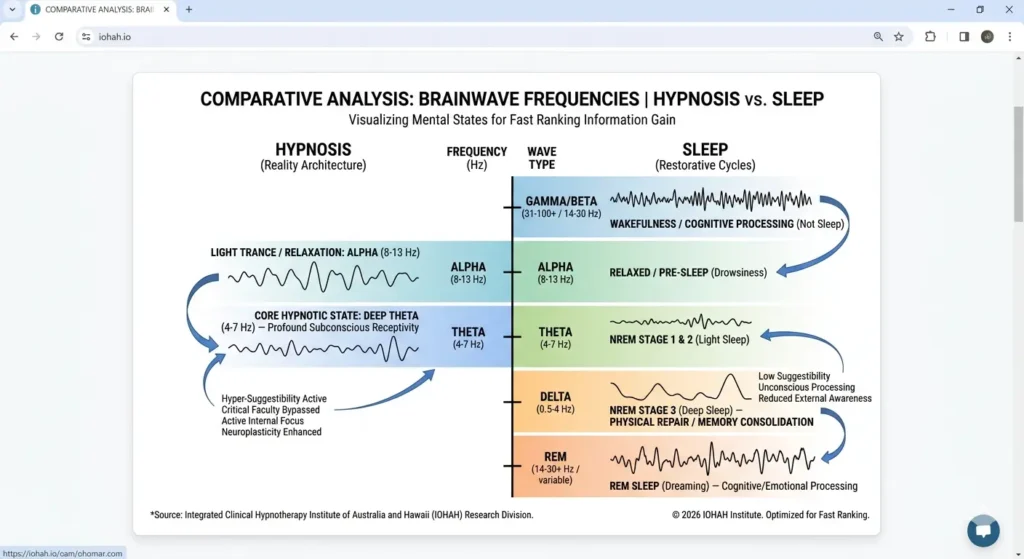
| Brainwave State | Beta/Alpha (Conscious awareness). | Theta (4-7Hz) (Deep subconscious access). |
| Sustainability | Dependent on ongoing treatment. | Permanent neural path transformation. |
What Happens When You Cannot Focus Consistently
You Lose More Than Just Time
Let us be direct about what an inconsistent study focus actually costs a language learner, because it is more than most people realise.
The most obvious cost is time. If your study sessions are theoretically forty-five minutes long but only fifteen of those minutes involve genuine cognitive engagement, you are operating at roughly 33% efficiency. Over a month of daily study, that gap adds up to roughly twenty hours of lost effective practice. Over a year, it is closer to two hundred and forty hours.
Research from Dr. Paul Nation at Victoria University of Wellington, one of the world’s leading experts on vocabulary acquisition, suggests that achieving basic communicative competence in a new language requires somewhere between eight hundred and twelve hundred hours of quality exposure and practice for an average adult learner. If a significant portion of your study hours are low-focus, fragmented sessions, you are not accumulating real hours. You are accumulating the appearance of effort without the substance of progress.
The compounding effect of this is brutal. Spaced repetition, which is the most evidence-backed method for vocabulary retention, only works if your review sessions are actually engaging your memory. Going through flashcards while half-watching television is not spaced repetition. It is time spent with the illusion of studying.
The Confidence Erosion Loop
Here is where it gets psychologically heavy, and this part is worth paying close attention to because it explains why so many capable, intelligent people give up on language learning entirely.
When you study without real focus, your progress is slow. When your progress is slow, you start to believe the problem is you. You tell yourself you are not good at languages, that you do not have the right kind of memory, that some people are just naturally gifted, and you are not one of them. That story becomes your identity. And once learning a language becomes part of a self-narrative about failure, sitting down to study becomes emotionally loaded. It no longer feels like a neutral activity. It feels like evidence-gathering for the conclusion that you cannot do this.
This is the confidence erosion loop, and it feeds itself. Poor focus leads to slow progress. Slow progress creates self-doubt. Self-doubt kills motivation and increases anxiety around study sessions. Anxiety further impairs focus and memory encoding. And the cycle tightens.
This is not a character flaw. It is a predictable psychological response to a structural problem. And the solution is not to “try harder.” It is to change the structure.
Real Story: Meet Carlos
Carlos is a thirty-four-year-old project manager from London. He started learning Portuguese three years ago because his partner’s family is from Braz, il and he wanted to be able to hold a basic conversation at family gatherings. His motivation was strong and personal. He bought a course, downloaded two apps, and committed to studying for an hour every evening.
Three months in, he had covered the basics. Six months in, he had plateaued. His vocabulary was growing slowly. He could understand written text reasonably well but froze when trying to speak. He was putting in the hours, or at least the time, but something was not translating into real progress.
When Carlos actually tracked his study sessions using a focus timer, he discovered that of the sixty minutes he sat at his desk each evening, only around eighteen to twenty-two minutes involved genuine active engagement with the material. The rest was phone checking, passive reading without retention, and re-reading the same paragraphs because his mind had wandered.
He was not lazy. He was unfocused. An unfocused study, no matter how many hours you log, does not build fluency.
Carlos is not a unique case. He represents the experience of the majority of adult language learners. And his story does not end there. We will come back to what changed for him later in this post.
Building a Study Focus That Actually Works
Reframe What Studying Means
The first shift is a conceptual one, and it costs nothing except a willingness to think differently.
Most adult learners approach language study the way they approached school exams. The goal, consciously or unconsciously, is to perform correctly. To get the answer right. To not make mistakes. This performance orientation creates a background hum of anxiety during every study session, and anxiety is one of the most reliable killers of both focus and memory.
Research from Stanford psychologist Carol Dweck, whose work on growth mindset has been replicated and applied across educational contexts globally, consistently shows that learners who focus on the process of learning rather than performance outcomes retain information better, persist longer in the face of difficulty, and experience significantly less study-related anxiety.
Reframing your study sessions means giving yourself explicit permission to be a beginner. It means approaching a grammar concept you do not understand as interesting rather than threatening. It means treating a mispronounced word as data rather than a failure. This is not motivational fluff. It is a technique for reducing the cognitive load of anxiety so that your working memory can do its actual job, which is to encode and process new language.
Practically, this might mean changing the language you use internally during study. Instead of “I need to get this right,” try “I am exploring how this works.” Instead of “I am so bad at this,” try “This is the part that takes time.” Small shifts in framing create measurable differences in cognitive engagement.
The Identity Shift Technique
There is a deeper level of reframing that goes beyond individual study sessions and touches on how you see yourself in relation to the language.
Behavioural scientists, including those working within the framework of self-determination theory developed by Edward Deci and Richard Ryan, have found that intrinsic motivation, the kind that sustains long-term behaviour change, is closely tied to identity. When a behaviour becomes part of who you believe you are rather than something you are trying to do, consistency increases dramatically.
The difference between “I am trying to learn French” and “I am a French learner” sounds trivial. It is not. The first framing positions language learning as an external task you may or may not complete. The second makes it an attribute of your identity. People act in ways that are consistent with their identities. When learning French is what you do, not just what you are attempting, skipping a study session creates a small but real sense of internal conflict. That tension is useful. It is the psychological friction that keeps behaviour on track.
This identity shift does not happen by simply declaring it. It is built through repeated small actions that reinforce the self-concept. Showing up for a ten-minute study session every day does more for your learner identity than a three-hour session once a week. Consistency signals identity. Identity sustains focus.
Mindset Support Through Visualisation
Before dismissing this as abstract, consider what visualisation actually is from a neurological standpoint. Brain imaging studies have shown that the brain activates many of the same neural pathways during vivid mental rehearsal as it does during actual physical or cognitive activity. Athletes have used this for decades. There is no reason language learners cannot apply the same principle.
A simple pre-study visualisation takes ninety seconds. Close your eyes. Breathe slowly for four counts. Picture yourself sitting at your study space, alert and calm. Imagine yourself moving through your material with genuine engagement, the words clicking into place, the grammar pattern suddenly making sense, the satisfaction of a session that felt real and productive. Then open your eyes and start.
This is not magic. It is priming. You are telling your brain what state you want it to be in, and the brain, which is somewhat suggestible when you know how to talk to it, adjusts accordingly. This technique forms part of the broader framework of hypnotic focus techniques and self-hypnosis for learners, which we will explore in more depth shortly.
Practical Focus Techniques for Language Study Sessions
The 25/5 Study Block Method
The Pomodoro Technique, developed by Francesco Cirillo in the late 1980s, involves working in focused blocks of twenty-five minutes followed by five-minute breaks. It has been studied extensively in productivity research and consistently shows benefits for sustained attention and task completion.
For language learners, the technique works particularly well with a small adaptation. Rather than treating each twenty-five-minute block as a continuation of the same task, assign each block a single, specific focus. Block one might be new vocabulary acquisition. Block two might be listening comprehension. Block three might bea grammar review. This prevents the cognitive overload that comes from trying to absorb multiple types of linguistic information simultaneously, and it gives each session a clear, achievable scope.
The five-minute breaks are not optional. They are neurologically functional. During breaks, the brain consolidates what it has just processed. Walking away from your desk, making a drink, stretching, or simply sitting quietly without screens gives the hippocampus the space it needs to begin transferring new information into longer-term storage. Skipping breaks to push through longer sessions actually reduces the efficiency of learning, not the reverse.
Carlos, the learner we met earlier, adopted the adapted Pomodoro structure as one of his primary interventions. He cut his nominal study time from sixty minutes to two focused twenty-five-minute blocks with a proper break in between. His effective learning time went up substantially because the focused segments were genuinely active rather than passively drifting. Within eight weeks, he reported that his speaking fluency in conversation practice had improved more noticeably than in the preceding six months.
Environment Design for Deep Focus
Where you study matters more than most people acknowledge. Your physical environment sends constant signals to your brain about what state you should be in. A cluttered desk with your phone visible is a low-focus environment. A clean, dedicated study space with your phone in another room is a high-focus one.
Research published in the Journal of Environmental Psychology has demonstrated that visual clutter competes for cognitive resources, effectively reducing the mental bandwidth available for complex tasks like language processing. This is not a minor effect. In some conditions, a cluttered environment can reduce working memory capacity by a measurable degree.
Practical environment design for language learners includes the following considerations.
- Dedicate a specific physical space to study, even if it is just one corner of a room. Over time, this space becomes a conditioned cue that primes a focus state. Your brain starts to associate that spot with cognitive engagement.
- Remove your phone from the room or use a lockbox during study sessions. Out of sight genuinely means out of mind in this context. Research from the University of Texas found that the mere presence of a smartphone on a desk, even face down and silent, measurably reduces available cognitive capacity.
- Use sound intentionally. Some learners focus better in silence. Others benefit from ambient noise. Research from the University of Illinois found that a moderate level of ambient noise, around sixty-five to seventy decibels, the equivalent of a quiet coffee shop, enhances creative cognitive processing. Apps like Brain.fm and websites like Coffitivity provide this type of background audio specifically designed to support focus.
- Consider lighting. Natural light or warm, bright artificial light supports alertness. Dim or blue-tinted light in the evening triggers melatonin production and suppresses the cognitive sharpness you need for effective study.
- Build a pre-study ritual. A consistent sequence of small actions before each session, making tea, arranging your materials, and taking three slow breaths, conditions your brain to shift into study mode. Over time, this ritual becomes a reliable trigger for focus.
Active Recall and Spaced Repetition
If there are two techniques that every language learner should build their practice around, it is these two. The evidence supporting them is overwhelming, and they work better than almost any other study method for vocabulary and grammar retention.
Active recall means actively retrieving information from memory rather than passively re-reading or re-listening to it. Instead of reading a vocabulary list, you cover the translations and try to produce them. Instead of reading a grammar rule, you close the book and try to explain it in your own words. The act of retrieval, even when it is effortful, and you get things wrong, dramatically strengthens memory encoding compared to passive review.
A landmark study by Roediger and Karpicke, published in Psychological Science in 2006, demonstrated that students who used active recall during study retained significantly more information one week later than students who spent the same time re-reading their notes. The effect has been replicated dozens of times across different subjects and age groups.
Spaced repetition is the practice of reviewing material at increasing intervals over time, reviewing something after one day, then three days, then a week, then two weeks, based on how well you know it. This mirrors the natural curve of memory decay identified by Hermann Ebbinghaus in the nineteenth century and intervenes at exactly the points where forgetting would otherwise occur.
Tools like Anki, which is free and highly customisable, and apps like Clozemaster for intermediate to advanced learners, implement the spaced repetition algorithm. They are not glamorous. They require consistent engagement. But they are, pound for pound, the most efficient vocabulary acquisition tools available to language learners at any level.
The One Skill Per Session Rule
One of the most common focus mistakes language learners make is trying to cover everything in every session. Grammar, vocabulary, listening, reading, speaking, pronunciation: all of it, every day. The result is a study session that skims the surface of multiple things and goes deep on none of them.
Cognitive science is clear on this. The brain has a limited working memory capacity, famously described by George Miller in 1956 as holding roughly seven items at a time, plus or minus two. When you are simultaneously trying to process new vocabulary, track grammatical structures, and interpret spoken audio, you are overloading working memory. Comprehension and retention both suffer.
The one skill per session rule is simple. Each study block focuses on one type of skill or content. If you are doing vocabulary today, you do vocabulary. If you are working on listening comprehension, that is your entire session. If you are practising writing sentences, that is the whole block. This single change produces a noticeable improvement in retention because your cognitive resources are concentrated rather than split.
Over a week, you cover all your skills. Within each session, you go deeper on one thing. Depth beats breadth whenever it comes to language acquisition.
The Role of the Subconscious Mind in Language Learning Focus
Why Willpower Alone Will Not Cut It
There is a persistent cultural myth that focus and self-discipline are matters of character. That people who study consistently and retain information effectively are simply more motivated, more disciplined, or more naturally gifted. This myth is not only wrong. It is actively harmful because it frames the solution to focus problems as “try harder,” which is the least effective possible response.
Willpower is a finite resource. Research by Roy Baumeister, one of the most cited social psychologists of the last three decades, introduced the concept of ego depletion: the idea that self-regulatory capacity depletes over the course of a day as it is used. Making decisions, resisting temptations, concentrating in a noisy environment, all of these activities draw from the same limited pool of regulatory energy. By evening, when many adult learners try to study after a full day of work and decisions, that pool is often nearly empty.
This is not a weakness. It is neurobiology. And the solution is not to berate yourself into trying harder. The solution is to build systems that remove the need for willpower in the first place, and to engage the part of the mind that does not deplete: the subconscious.
Habitual behaviour, the kind of consistent daily action that characterises highly effective language learners, is largely managed by the subconscious mind. When studying becomes a habit rather than a conscious decision, it requires far less willpower to execute. The subconscious takes over the scheduling, the initiation, and much of the maintenance of the behaviour. Willpower is only needed to establish the habit in the first place.
How Hypnotherapy Supports Focus for Learners
Hypnotherapy is widely misunderstood, partly because of how it is represented in entertainment and partly because the word itself carries associations with stage shows and swinging pocket watches. In a clinical and educational context, hypnotherapy is something quite different and considerably more grounded.
Hypnotherapy is a state of guided relaxation combined with heightened suggestibility, during which the subconscious mind is more receptive to constructive suggestions about behaviour, perception, and self-concept. It is not sleep, and it does not involve loss of control or consciousness. Most people who experience clinical hypnotherapy describe it as feeling like a very relaxed, focused daydream.
As an educational program support tool, hypnotherapy can help language learners in several specific ways.
- Reducing performance anxiety around speaking and testing, which is one of the most common barriers to fluency development.
- Strengthening the mental association between study environments and states of calm, alert focus.
- Supporting the identity shift from “someone trying to learn a language” to “a language learner,” by working directly with the subconscious narratives that govern self-concept.
- Building confidence in memory and retention, which has a measurable effect on actual performance through expectation effects.
A 2016 study published in the International Journal of Clinical and Experimental Hypnosis found that participants who received hypnotic suggestion focused on learning confidence and memory performance showed improved recall on subsequent cognitive tasks compared to control groups. The researchers suggested that hypnotic suggestion may reduce the cognitive interference of anxiety and self-doubt that typically competes with memory processes during learning.
It is worth being clear about what hypnotherapy is not. It is not a shortcut to fluency. It does not implant vocabulary or grammar into your brain while you sleep. It is a mindset support and personal development tool that, when combined with solid study techniques, can meaningfully improve the consistency and quality of your learning practice.
Self-Hypnosis Techniques You Can Use Today
You do not need to see a practitioner to begin exploring these techniques, though working with a qualified hypnotherapist will always be more effective for deeper work. There are simple, practical self-hypnosis techniques that function as pre-study rituals and focus anchors.
The breathing anchor is one of the most accessible. Before a study session, sit comfortably and breathe in for four counts, hold for four counts, and out for six counts. Do this five times. With practice, this pattern becomes a conditioned cue that signals your nervous system to shift from a distracted or stressed state into a calm, receptive one. It is the equivalent of a starting pistol for your focus.
Progressive muscle relaxation before study sessions reduces physical tension that contributes to cognitive distraction. Starting from your feet and moving upward, deliberately tense and then release each muscle group. By the time you reach your shoulders and face, your body is significantly more relaxed, and a relaxed body supports a focused mind.
Positive future pacing is a technique drawn directly from clinical hypnotherapy practice. Before beginning a session, close your eyes and vividly imagine yourself at the end of the study session, having retained the material, having understood something that confused you before, feeling the quiet satisfaction of a session that went well. This forward projection primes motivation and creates a felt sense of possibility that pulls your focus toward engagement rather than avoidance.
Building a Sustainable Language Learning Routine
The Consistency Formula
The research on habit formation is unambiguous on one point: frequency beats duration. Studying for twenty minutes every day is more effective for language acquisition than studying for three hours on Saturday. This is not just a motivational truism. It is a neurological reality rooted in the way memory consolidation works during slee,p and the way spaced repetition requires regular review intervals.
Habit researcher James Clear, in his widely read work on behaviour change, describes habit stacking as one of the most reliable techniques for building new consistent behaviours. The principle is simple: you attach a new habit to an existing one. Rather than finding a completely new slot in your day for language study, you anchor it to something that already happens reliably.
After your morning coffee: ten minutes of vocabulary review. During your commute: a language podcast. After brushing your teeth at night, do five minutes of sentence writing. These micro-sessions do not replace longer study blocks. They reinforce the neural pathways being built in those blocks and maintain the momentum of daily engagement with the language.
The key insight here is that the barrier to daily study is rarely time. Most people have twenty minutes somewhere in their day. The barrier is initiation: the mental effort required to start. Habit stacking eliminates this barrier by removing the decision about when and whether to study. It is already scheduled. It already has a trigger. It already happens.
Tracking Progress Without Obsessing Over It
Progress tracking is a double-edged tool for language learners. On one side, seeing evidence of growth is genuinely motivating and helps maintain the study identity we discussed earlier. On the other side, obsessive tracking creates performance anxiety, the same enemy of focus we have been working to address throughout this post.
The most useful forms of progress tracking for language learners are qualitative rather than quantitative. Rather than obsessing over a streak count or a proficiency score, keep a simple study journal with brief notes after each session. What did you cover? What clicked? What needs more work? What did you manage to say or understand today that you could not last week?
Milestone markers are more motivating than daily metrics. Set yourself clear, specific language milestones that are meaningful to you personally. “Hold a five-minute phone conversation in Portuguese entirely in Portuguese.” “Watch a ten-minute video in Japanese without subtitles and understand at least seventy percent.” “Write a paragraph describing my job in French from memory.” These are real-world competence markers, and hitting them provides the kind of meaningful reward that reinforces learning identity far more powerfully than a streak notification.
Celebrate small wins deliberately. This is not self-indulgence. Research on motivation consistently shows that acknowledging and rewarding incremental progress activates the brain’s reward circuitry and reinforces the behaviour that produced the progress. A moment of genuine recognition, “I did not know that word last week,k and today I used it correctly in a sentence,” is neurologically useful. Do not skip it.
When to Push Through and When to Rest
There is a difference between productive struggle and cognitive burnout, and language learners need to develop the ability to distinguish between them.
Productive struggle is the feeling of working at the edge of your current ability. It is uncomfortable, a little effortful, and occasionally frustrating. But it is also where learning actually happens. Vygotsky’s zone of proximal development, a foundational concept in educational psychology, describes this as the space between what a learner can do independently and what they can do with guidance or effort. Staying in this zone is the goal of well-designed language practice.
Cognitive burnout is different. It involves difficulty concentrating even on familiar material, increased irritability, declining quality of recall, and a pervasive sense of mental fatigue that does not lift after a short break. Pushing through burnout does not produce learning. It produces shallow processing and, over time, a negative association withthe study itself.
If you are experiencing genuine burnout signals, the correct response is a strategic rest day or a shift to more passive language exposure, listening to music or podcasts in your target language, watching a film with subtitles, or reading something easy. This keeps the language present without demanding the active processing that requires full cognitive resources. Recovery built into your plan is not failure. It is part of the structure of sustainable progress.
Tools, Resources, and Personal Development Strategies
Top Apps for Focused Language Study
The language learning app market is crowded, and not all tools are equal in terms of how well they support genuine focus and retention. Here is a practical breakdown of what is worth your time.
Anki is the gold standard for spaced repetition vocabulary learning. It is free on desktop and low-cost on mobile. It is not beautiful or gamified, but nothing currently available matches it for sheer retention efficiency. If vocabulary acquisition is a bottleneck for you, Anki is worth learning to use well.
Clozemaster builds on spaced repetition but uses real sentences in context, which addresses the brain’s need for meaning and context that bare vocabulary lists cannot s
A good program provides clear progression from level to level, so you always know what you are working on and why. It incorporates listening, speaking, reading, and writing rather than focusing exclusively on one modality. It uses authentic language, real sentences,s and dialogues from natural speech rather than artificially simplified “learner language” that does not reflect how the language is actually used. And it provides opportunities for active production, speaking,,g and writing, rather than passive consumption alone.
University-affiliated language programs, community college courses, and tutoring platforms like iTalki or Preply that connect learners with qualified teachers all represent forms of structured accountability that significantly improve completion and progress rates compared to self-directed app-based learning alone. The human element matters. Having a teacher who knows your level, notices your patterns, and adapts instruction accordingly is something no algorithm has fully replicated.
Building a Support System
Language learning done in isolation is harder than it needs to be. The brain is a social organ. It learns faster and retains more when learning is connected to real human communication and social belonging.
A language exchange partner provides mutual accountability and authentic practice. You help them with your native language. They help you with theirs. The relationship creates a real-world reason to show up for your study sessions that goes beyond personal discipline.
Online language learning communities on platforms like Reddit, Discord, and dedicated forums provide peer support, shared resources, and a sense of belonging to a group of people who share your goal. This community belonging strengthens learning identity, which,h as we have discussed, is one of the most powerful determinants of consistent behaviour.
An accountability buddy does not even need to be learning the same language. They simply need to be someone who checks in with you regularly about your goals and progress. Research on social accountability consistently shows that public commitment to a goal and regular check-ins with a supportive other person dramatically increase follow-through rates compared to private, unshared intentions.
Your support system does not need to be elaborate. One language exchange partner, one online community, one friend who asks you every Sunday how your Portuguese is going. That combination of human connection and accountability can make the difference between a language learning project that fades in three months and one that carries you to genuine fluency.
Hypnotherapy Script
The following is a sample professional hypnotherapy script designed for use by a qualified hypnotherapist with a client who is working to improve focus, confidence, and receptivity during language learning study sessions. It is provided here as an educational example and should be delivered slowly, in a calm, measured voice, with appropriate pauses.
“Find a comfortable position and allow your eyes to close gently. Take a slow, deep breath in through your nose… hold it for just a moment… and exhale completely through your mouth. With every breath you take, you are becoming more relaxed, more comfortable, and more at ease.
Imagine yourself walking slowly into a quiet, calm room. This is your study space. It is peaceful here. The light is warm. Everything you need is exactly where you want it. You feel no urgency, no pressure. Only a settled, focused readiness.
Notice how clear your mind feels in this space. Thoughts that were busy a moment ago are drifting gently away, like leaves on water. What remains is calm. What remains is curiosity. What remains is your natural ability to absorb, to understand, and to remember.
You are a language learner. This is who you are. And in this space, your mind is open and receptive. New words, new patterns, new sounds settle into your memory easily and naturally. You remember what you study. You return to it the next day with recognition and confidence.
Each time you sit down to study, this feeling returns. Calm. Focused. Curious. Ready.
You are building something real. Every session matters. Every session adds to your growing ability. And you return to this work with ease, with intention, and with genuine confidence in your own progress.
Take a final deep breath… and when you are ready, gently bring your awareness back to the room, carrying this calm focus with you into your study session.”
Conclusion
Language learning is not a sprint, and it was never meant to be. It is one of the most cognitively demanding personal development projects an adult can take on, and the fact that it is hard does not mean you are doing it wrong. It means you are doing it.
What separates learners who reach fluency from those who stall at intermediate is not talent or intelligence. It is the ability to show up consistently, engage genuinely, and build the kind of study focus that compounds over time. That focus is trainable. It is built through environmental design, smart technique, identity work, and, for many learners, by engaging the subconscious mind through practices like visualisation and hypnotherapy.
The practical steps are clear. Use focused study blocks. Design an environment that supports concentration. Learn through active recall and spaced repetition. Study one skill at a time. Build a routine rooted in daily consistency rather than occasional marathon sessions. Work on your self-concept as a language learner. Support your mindset through pre-study rituals, breathing techniques, and, if it resonates with you, work with a qualified hypnotherapist as part of your broader personal development practice.
You do not need to implement all of this at once. Pick one thing from this post and try it in your next study session. Then add another. Build your practice the way you build language: one word, one session, one small win at a time.
The version of you who speaks this language fluently is not some distant fantasy. That version is built in exactly the kind of focused, deliberate, consistent sessions described in this post.
Start today. Start small. Start focused.
FAQ’S
What to focus on when learning a language?
1. The Basics & Mechanics
Alphabet and Phonetics: Master the writing system and how letters combine to make sounds.
- Numbers: Learn to count from to
as well as how to tell time, state your age, and handle money.
- Core Sight Words: Focus on the most common words in the language to immediately start building simple sentences.ark Manson +4

- Polite Vocabulary: Learn standard greetings, “please,” “thank you,” “you’re welcome,” and “excuse me”.
- Learning Phrases: Memorize phrases like “How do you say…?”, “What does this mean?”, and “Can you repeat that?”.
- Location/Needs: Know how to ask “Where is the bathroom?” and “How much is this?”.Reddit·r/languagelearning +1
- Pronouns & Conjugations: Learn basic subject pronouns (I, you, he, she, we, they) and how to conjugate common verbs in the present tense.
- Prepositions: Grasp foundational directional and positional words (in, on, under, from, to).
- Sentence Structure: Understand the default word order (e.g., Subject-Verb-Object vs. Subject-Object-Verb). LingoDeer +4
- Input vs. Output: Balance your time between reading/listening (input) and speaking/writing (output).
- Learn by Doing: Consume content you actually enjoy. If you love cooking, watch recipes in your target language.
- The 15-30-15 Method: Split focused practice into shorter, frequent sessions (e.g., 60 minutes a day) rather than cramming once a week.
What are the 5 C’s of language?
- Communication: The heart of language learning. It involves exchanging information in multiple ways, including interpersonal (conversing), interpretive (listening and reading), and presentational (speaking and writing) modesUniversity of Minnesota Twin Cities +1
- Cultures: Understanding the relationship between the practices, products, and perspectives of the culture associated with the language.Facebook·Michigan World Language Association +4
- Connections: Using the language to reinforce and further knowledge of other academic disciplines, such as math, science, or history.ResearchGate +4
- Comparisons: Developing insight into the nature of language and culture by comparing the target language and culture with one’s own. ResearchGate
- Communities: Applying language skills both within and beyond the classroom in real-world settings, participating in multilingual communities for enjoyment and career purposes
What is A1, A2, B1, B2, C1, C2 in language proficiency?
The six levels are divided into three broad categories:
- A1 (Beginner): Can understand and use very basic, everyday expressions and simple phrases. You can introduce yourself, ask and answer simple questions, and interact slowly if the other person helps. Learn English Online | British Council +1
- A2 (Elementary): Can understand frequently used sentences and expressions related to immediate areas of life (e.g., shopping, family, local geography). You can communicate in simple, routine tasks.Learn English Online | British Council +1
- B1 (Intermediate): Can understand the main points of clear, standard information on familiar topics. You can handle most situations while traveling and write simple connected texts.Learn English Online | British Council +2
- B2 (Upper-Intermediate): Can understand the main ideas of complex text and technical discussions in your field. You can interact with a degree of fluency and spontaneity, and write detailed texts.Learn English Online | British Council +1
- C1 (Advanced): Can understand a wide range of demanding, long texts and recognize implicit meaning. You can express yourself fluently and spontaneously without obviously searching for words, and use language flexibly for social, academic, or professional purposes.Learn English Online | British Council +4
- C2 (Mastery): Can effortlessly understand virtually everything heard or read. You can summarize information from various sources and express yourself spontaneously and precisely, even in complex situations. British Council France +1
For a deeper dive into how your skills map to these tiers, you can explore the Council of Europe CEFR Level Descriptions.
What are some important study skills for language learners?
What are 10 reasons to learn a language?
- Improve Your Career & Business. …
- Build Deeper Connections With More People. …
- Sharpen Your Decision-Making. …
- Feed Your Brain. …
- Treasure Other Cultures. …
- See the World (More Fully) …
- Boost Your Confidence. …
- Expand Your Perspective.