

Self Hypnosis Clinical Hypnotherapy Bali 2026
Table of Contents
A Comprehensive, Practical, and In-Depth Guide (Approx. 5000 Words)
Introduction: The Power of Turning Inward
In a world that constantly demands outward attention—notifications, deadlines, conversations, responsibilities—there is something profoundly powerful about learning to turn inward and influence your own mental state. Self-hypnosis is one of the most effective, structured, and scientifically grounded ways to do exactly that.
Self-hypnosis is not about losing control. It is about gaining it.
Read more:
Ericksonian Hypnosis Clinical Hypnotherapy
It is not about being passive. It is about becoming an active participant in shaping your thoughts, emotions, and behaviors at the deepest level—the subconscious mind.
Clinical hypnotherapy has long been used by trained professionals to help individuals manage anxiety, overcome phobias, improve sleep, reduce pain, and change deeply ingrained habits. Self-hypnosis is the extension of that process into your own hands. It allows you to access similar benefits independently, consistently, and with increasing precision over time.
This guide will explore self-hypnosis from every angle: what it is, how it works, its neurological basis, its clinical applications, and a step-by-step system for practicing it effectively.
What Is Self-Hypnosis?
Self-hypnosis is a self-directed process in which you intentionally guide yourself into a focused, relaxed mental state—commonly referred to as a trance—and then introduce targeted suggestions, imagery, or mental rehearsals to influence subconscious patterns.
At its core, self-hypnosis involves three key elements:
Focused Attention – narrowing your awareness to a specific internal experience
Deep Relaxation – reducing physical and mental tension
Increased Suggestibility – becoming more receptive to internal ideas and imagery
Unlike stage hypnosis, self-hypnosis is:
Fully conscious
Voluntary
Controlled by the individual
Goal-oriented
You are not being “put under.” You are guiding yourself inward.
Self-Hypnosis vs Clinical Hypnotherapy
Understanding the relationship between self-hypnosis and clinical hypnotherapy helps clarify its role.
Clinical Hypnotherapy
Conducted by a trained practitioner
Tailored to individual psychological needs
Often used for complex issues (trauma, chronic anxiety, behavioral disorders)
Includes advanced techniques like regression, parts therapy, and ideomotor signaling
Self-Hypnosis
Self-directed practice
Structured but flexible
Ideal for habit change, stress management, confidence, sleep, and performance
Builds independence and long-term mental conditioning
Think of clinical hypnotherapy as guided intervention, and self-hypnosis as ongoing training.
The Science Behind Self-Hypnosis
Self-hypnosis is not mystical—it is neurological.
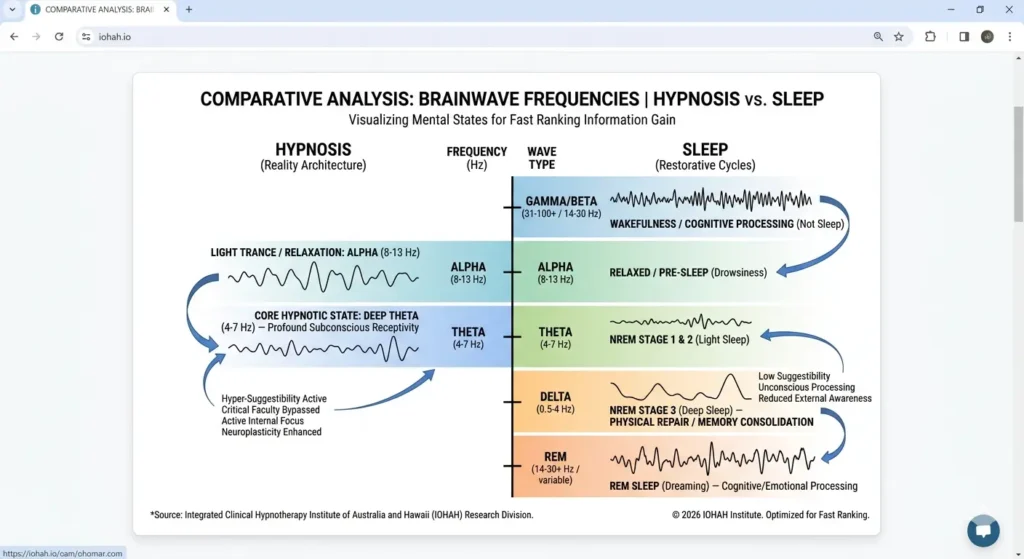
Brainwave States
Your brain operates across different frequency patterns:
Beta (13–30 Hz): Active thinking, problem-solving
Alpha (8–12 Hz): Relaxed focus, light meditation
Theta (4–8 Hz): Deep relaxation, trance, subconscious access
Self-hypnosis works by shifting your brain from beta into alpha and theta states.
In these states:
The analytical mind quiets
Internal imagery becomes more vivid
Emotional learning increases
Suggestibility rises
Neurological Changes
Research using brain imaging has shown:
Reduced activity in areas linked to self-criticism and worry
Increased connection between emotional and cognitive centers
Decreased “mental chatter”
This creates an ideal environment for change.
Related Research Modules
Why Self-Hypnosis Works
Most behavior is not consciously chosen—it is automatic.
Habits, emotional reactions, beliefs, and behavioral patterns are stored in the subconscious mind. Traditional self-help often fails because it targets conscious thinking rather than subconscious programming.
Self-hypnosis works because it:
Bypasses conscious resistance
Engages emotional and sensory learning
Uses repetition and imagery
Rewrites automatic responses
It speaks the language of the subconscious.
Connecting with the Subconscious for Positive Change
Sit comfortably and allow your eyes to close. Take a slow breath in… and release it fully. Let your body settle with each breath.
Now bring your awareness inward. Notice the quiet space behind your thoughts. There is nothing you need to force.
I will count from five down to one, and with each number, your mind becomes more calm and receptive.
Five… relaxing.
Four… letting go.
Three… calm and steady.
Two… focused inward.
One… deeply settled.
In this state, your subconscious mind is open in a natural and safe way.
Allow this idea to form gently:
Each day, you respond with greater awareness.
You notice your thoughts without reacting immediately.
You choose calm, steady responses.
This becomes easier with practice.
It becomes natural.
It becomes automatic.
In a moment, I will count from one to five.
One… returning slowly.
Two… becoming aware.
Three… refreshed.
Four… almost back.
Five… eyes open, calm and clear
You might also find these helpful:
The Core Components of Self-Hypnosis
A structured self-hypnosis session typically includes:
Preparation
Induction
Deepening
Suggestion
Visualization
Emergence
Anchoring
Each step serves a specific purpose.
Step-by-Step Self-Hypnosis Process
Step 1: Set a Clear Intention
Your subconscious responds to clarity.
Avoid vague goals like:
“I want to feel better”
Instead use:
“I feel calm and relaxed when I go to bed”
“I respond to pressure with confidence and clarity”
Guidelines:
Use present tense
Keep it specific
Focus on one goal at a time
| Aspect | Traditional Approach (Relief) | IOHAH Advanced Science (Removal) |
| Primary Goal | Manage symptoms via external care. | Resolve root causes via Subconscious Re-wiring. |
| Brainwave State | Beta/Alpha (Conscious awareness). | Theta (4-7Hz) (Deep subconscious access). |
| Sustainability | Dependent on ongoing treatment. | Permanent neural path transformation. |
Step 2: Prepare Your Environment
Create conditions that support relaxation:
Quiet, uninterrupted space
Comfortable position (sitting or lying)
Dim lighting
Phone off or silent
Consistency helps your brain associate the environment with the hypnotic state.
Step 3: Induction
The induction shifts your mind into a relaxed state.
A simple method:
Close your eyes
Take slow, deep breaths
Count down from 10 to 1
With each number, relax deeper
Example:
“Ten… relaxing… nine… deeper… eight… letting go…”
Step 4: Deepening
Deepening strengthens the trance.
Common techniques:
Staircase visualization
Elevator descent
Floating or sinking sensations
Example:
“Each step down takes me deeper into calm…”
Step 5: Suggestion and Visualization
This is the core of the practice.
Direct Suggestion
Repeating clear, positive statements
Example:
“I am calm and confident in all situations.”
Visualization
Mentally experiencing success
Example:
Seeing yourself performing confidently in a meeting
Use:
Sensory detail (sight, sound, feeling)
Emotional engagement
Step 6: Emotional Reinforcement
Emotion amplifies learning.
Feel:
Confidence
Calm
Control
The stronger the emotion, the deeper the imprint.
Step 7: Emergence
Return gradually:
Count from 1 to 5
Increase alertness
Open eyes slowly
Step 8: Anchoring
Create a physical trigger for the state.
Example:
Press thumb and finger together
Take a specific breath
Repeat consistently to condition the response.
Applications of Self-Hypnosis
Self-hypnosis is widely used across multiple areas.
1. Stress and Anxiety Management
Calms the nervous system
Reduces overthinking
Creates emotional stability
2. Sleep Improvement
Reduces mental chatter
Promotes faster sleep onset
Improves sleep quality
3. Confidence Building
Reprograms self-image
Reduces fear responses
Enhances performance
4. Habit Change
Addresses subconscious triggers
Replaces automatic behaviors
Reinforces new patterns
5. Pain Management
Alters perception of discomfort
Enhances relaxation response
6. Focus and Performance
Improves concentration
Strengthens mental rehearsal
Enhances execution under pressure
Common Misconceptions
Myth 1: You Lose Control
Reality: You remain fully aware and in control.
Myth 2: You Can Get Stuck
Reality: The hypnotic state is natural and temporary.
Myth 3: It’s Only for Certain People
Reality: Most people can learn it with practice.
Myth 4: It’s the Same as Sleep
Reality: It is a distinct, alert mental state.
Building a Daily Practice
Consistency is everything.
Recommended Routine:
10–20 minutes daily
Same time each day (morning or evening)
Same structure
What to Expect:
Week 1–2:
Learning the process
Mild relaxation
Week 3–4:
Deeper trance
Subtle changes
Week 5–8:
Noticeable behavioral shifts
Reduced effort in change
Challenges and How to Overcome Them
1. Wandering Mind
Normal and expected
Gently return focus
2. Doubt
Trust the process
Focus on consistency
3. Falling Asleep
Sit upright
Practice earlier in the day
4. Impatience
Subconscious change takes repetition
Advanced Techniques
Once comfortable, you can explore:
Future Pacing
Mentally rehearsing future success
Parts Therapy (Simplified)
Dialoguing with different aspects of yourself
Symbolic Visualization
Using metaphors to represent change
Emotional Release Work
Letting go of stored tension safely
Ethical and Safety Considerations
Self-hypnosis is generally safe, but:
Avoid deep trauma work without professional support
Use positive, constructive suggestions
Stay grounded in reality
For complex issues, consult a qualified hypnotherapist.
The Long-Term Impact
With consistent practice, self-hypnosis can:
Change default emotional responses
Improve resilience
Increase self-awareness
Enhance overall well-being
The most important shift is this:
You stop reacting automatically and start responding intentionally.
Conclusion: Mastering Your Inner State
Self-hypnosis is not a quick fix. It is a skill.
A powerful one.
It gives you direct access to the level of mind where habits are formed, emotions are triggered, and behaviors are generated.
Most people spend years trying to change from the surface.
Self-hypnosis works at the root.
Fifteen minutes a day can begin to reshape how you think, feel, and respond—not through force, but through alignment.
Start simple.
Stay consistent.
And give your subconscious the repetition it needs to change.
Because once your internal patterns shift, everything built on top of them begins to change as well.
This content is curated and reviewed by Issa, the lead educator at the Integrated Clinical Hypnotherapy Institute of Australia and Hawaii (IOHAH). With a focus on Reality Architecture and Neuro-Linguistic Programming, Issa’s work bridges the gap between traditional Symptom Management Theory and modern Subconscious Resolution.
Expertise: Clinical Hypnotherapy, NLP Master Practitioner.
Focus: Advancing the science of non-pharmacological symptom removal.