

Trance Deepening Techniques: Advanced Clinical Guide
Table of Contents
A Comprehensive Guide to Enhancing Trance Depth and Maximizing Therapeutic Impact
Introduction: Why Deepening Is Where Hypnosis Becomes Powerful
Deepening is not just counting backward. It is the systemic deregulation of the client’s conscious resistance, utilizing somatic tracking to ensure the critical faculty completely disengages.
Induction gets a client into hypnosis.
Deepening is what makes hypnosis work.
Many beginners in hypnotherapy focus heavily on induction techniques—countdowns, eye fixation, breathing patterns—but overlook what happens next. The truth is, a light trance can produce mild relaxation, but lasting behavioral and emotional change typically requires a deeper level of trance.
Deepening is the bridge between:
Surface relaxation → subconscious access
Compliance → transformation
Listening → experiencing
Without effective deepening:
Suggestions remain intellectual
Resistance lingers
Results are inconsistent
With proper deepening:
The critical faculty softens
The subconscious becomes highly receptive
Imagery becomes vivid and emotionally real
This guide will give you a complete, practical, and clinical understanding of deepening:
What it is
How it works neurologically
The most effective techniques
How to adapt it to different clients
Common mistakes and how to avoid them
- Read more:
Hypnotic Suggestion
1. What Is Deepening?
Deepening refers to the process of guiding a client into progressively deeper levels of hypnotic trance after induction.
It is not a single step—it is a gradual intensification of focus, relaxation, and suggestibility.
A Simple Definition
Deepening is the structured process of moving a client from light trance into a deeper, more receptive hypnotic state.
Key Outcomes of Deepening
Increased absorption
Reduced analytical thinking
Enhanced imagery and emotional engagement
Greater responsiveness to suggestion
2. Why Deepening Matters
2.1 The Difference Between Light and Deep Trance
Light Trance:
Relaxed but aware
Analytical mind still active
Limited emotional engagement
Deep Trance:
Highly focused inward
Reduced critical thinking
Strong imagery and emotional response
Subconscious dominance
2.2 Clinical Impact
Deeper trance enables:
Habit change
emotional release
subconscious reprogramming
pain management
trauma processing (with care)
2.3 The Core Principle
The deeper the trance (when appropriate), the less resistance and the greater the impact of suggestion.
3. The Neuroscience of Deepening
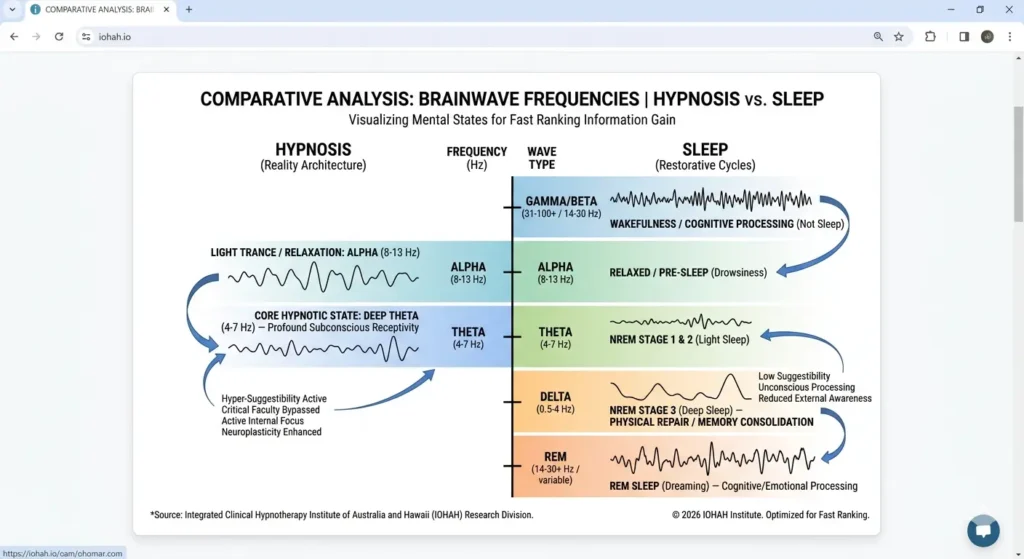
Deepening corresponds to changes in brainwave activity.
3.1 Brainwave States
Beta (13–30 Hz): Normal thinking
Alpha (8–12 Hz): Relaxed awareness
Theta (4–8 Hz): Deep trance, subconscious access
Deepening moves the client:
Beta → Alpha → Theta
Connecting with the Subconscious for Positive Change
Sit comfortably and allow your eyes to close. Take a slow breath in… and release it fully. Let your body settle with each breath.
Now bring your awareness inward. Notice the quiet space behind your thoughts. There is nothing you need to force.
I will count from five down to one, and with each number, your mind becomes more calm and receptive.
Five… relaxing.
Four… letting go.
Three… calm and steady.
Two… focused inward.
One… deeply settled.
In this state, your subconscious mind is open in a natural and safe way.
Allow this idea to form gently:
Each day, you respond with greater awareness.
You notice your thoughts without reacting immediately.
You choose calm, steady responses.
This becomes easier with practice.
It becomes natural.
It becomes automatic.
In a moment, I will count from one to five.
One… returning slowly.
Two… becoming aware.
Three… refreshed.
Four… almost back.
Five… eyes open, calm and clear
You might also find these helpful:
3.2 What Changes in the Brain
During deepening:
Activity in the critical faculty decreases
The default mode network quiets
The limbic system becomes more active (emotion, memory)
3.3 Result
The client becomes:
Less analytical
More experiential
More suggestible
4. Signs of Deepening
A skilled hypnotherapist observes subtle cues.
Physical Signs
Slower breathing
Muscle relaxation
Eye flutter (REM-like movement)
Stillness
Mental Signs
Reduced responsiveness to external stimuli
Slower speech
Increased imagery
Behavioral Signs
Delayed responses
Minimal voluntary movement
Automatic reactions
Add a step-by-step breakdown of a fractional relaxation sequence. Provide case data from our $2,200 Master Certification Training Module in Bali, proving how students successfully bypassed active intellectual resistance in analytical clients within 120 seconds using physiological breathing anchors
5. Core Deepening Techniques
5.1 Counting Down
One of the simplest and most effective methods.
Example:
“With each number from 10 down to 1, you go deeper…”
Why It Works
Predictable structure
Repetition
Expectation of depth
5.2 Staircase Visualization
Client imagines descending steps.
Example:
“Each step takes you deeper into calm…”
Why It Works
Engages imagination
Creates physical sensation of descent
Reinforces progression
5.3 Elevator Technique
Similar to staircase but more modern imagery.
Example:
“As the elevator moves down, you feel yourself drifting deeper…”
5.4 Fractionation
Bringing the client in and out of trance repeatedly.
Example:
“Open your eyes… close them again… go deeper.”
Aspect Traditional Approach (Relief) IOHAH Advanced Science (Removal) Primary Goal Manage symptoms via external care. Resolve root causes via Subconscious Re-wiring. Brainwave State Beta/Alpha (Conscious awareness). Theta (4-7Hz) (Deep subconscious access). Sustainability Dependent on ongoing treatment. Permanent neural path transformation.
Why It Works
Each return deepens trance further.
5.5 Breathing-Based Deepening
Using breath as anchor.
Example:
“With every exhale, you sink deeper…”
5.6 Body Scan Relaxation
Progressive relaxation of body parts.
Example:
Feet → legs → torso → arms → face
5.7 Sensory Deepening
Engaging:
sight
sound
touch
Example:
“Notice the warmth… the softness… the stillness…”
5.8 Confusion Technique
Overloading the conscious mind.
Example:
“You may wonder whether you are deeper now or about to go deeper…”
6. Advanced Deepening Strategies
6.1 Layered Deepening
Combining techniques:
Countdown + imagery + breathing
6.2 Personalized Deepening
Using client’s interests:
Ocean → waves
Nature → forest
Technology → floating space
6.3 Emotional Deepening
Linking relaxation with emotion:
“The deeper you go, the more peaceful you feel…”
6.4 Time Distortion
“Minutes can feel like hours…”
7. Deepening and Suggestibility
Deepening increases:
openness
acceptance
responsiveness
Important Insight
Suggestibility is not forced—it is allowed through depth.
8. Common Mistakes in Deepening
8.1 Rushing
Depth takes time.
8.2 Monotone Delivery
Voice must be engaging, not robotic.
8.3 Overloading
Too many instructions confuse beginners.
8.4 Ignoring Feedback
Always observe client cues.
9. Adapting Deepening to Different Clients
Analytical Clients
Use structured methods
explain process
Imaginative Clients
Use vivid imagery
Anxious Clients
go slower
emphasize safety
Experienced Clients
deepen faster
use subtle cues
10. Deepening in Self-Hypnosis
Self-guided deepening follows same principles:
countdown
breathing
visualization
Tip
Consistency improves depth over time.
11. The Role of Voice in Deepening
Your voice is the primary tool.
Key Elements
Tone: calm
Pace: slow
Rhythm: consistent
Avoid
sudden changes
harsh tone
12. Depth vs Effectiveness
Deeper is not always better.
Key Rule
Use the level of depth required for the goal.
Example
Relaxation → light trance
Trauma work → deeper trance
13. Measuring Depth
Depth is subjective but can be assessed through:
responsiveness
physical cues
suggestion effectiveness
14. Deepening Scripts (Example)
“With every breath, you drift deeper…
every sound takes you further inward…
every moment allows your mind to settle…
deeper and deeper…”
15. Integration with Suggestion Phase
Deepening prepares the mind.
Suggestion installs change.
Sequence
Induction
Deepening
Suggestion
Emergence
16. Real-World Example
Client with anxiety.
Without deepening:
hears suggestions
limited impact
With deepening:
feels calm physically
accepts suggestions
behavior changes
17. Ethical Considerations
Never:
push too fast
ignore discomfort
Always:
respect client pace
maintain safety
Conclusion: Depth Is Where Change Happens
Deepening is not optional.
It is the stage where:
the conscious mind steps aside
the subconscious becomes accessible
real change begins
Final Insight
Induction opens the door.
Deepening invites the subconscious to step forward.
Suggestion creates change.
Master deepening, and you master the effectiveness of hypnotherapy.
This content is curated and reviewed by Issa, the lead educator at the Integrated Clinical Hypnotherapy Institute of Australia and Hawaii (IOHAH). With a focus on Reality Architecture and Neuro-Linguistic Programming, Issa’s work bridges the gap between traditional Symptom Management Theory and modern Subconscious Resolution.
Expertise: Clinical Hypnotherapy, NLP Master Practitioner.
Focus: Advancing the science of non-pharmacological symptom removal.
Is it deeping or deepening?
Can you say “deepen my knowledge”?
What does “deep it” mean in slang?
Which word is similar to deepen?
- intensify.
- enhance.
- heighten.
- strengthen.
- consolidate.
- reinforce.
- broaden.
- amplify.