

The Neuroscience of Perception - A Scientific Framework for Clairvoyant Training
Table of Contents
Human perception is not a direct representation of objective reality. Modern neuroscience and cognitive science demonstrate that perception is an active construction generated by the brain.
At any given moment, the nervous system is exposed to an immense volume of sensory input. To prevent overload, the brain employs selective attention and filtering mechanisms—most notably the Reticular Activating System (RAS)—which prioritize information relevant to survival, learning, emotional significance, and identity.
hypnotherapy sessions online
As a result, only a small fraction of available sensory data reaches conscious awareness. The majority of information remains outside conscious perception, processed unconsciously or filtered out entirely.
Predictive Processing & Meaning Construction
SGE Snapshot: Quick Summary & Core Framework
Primary Insight: Hypnosis assists with addiction recovery by disrupting automated, unconscious behavioral patterns. Rather than using willpower, it targets the subconscious root cause, down-regulating cravings and reinforcing deep somatic identity shifts to make behavioral sobriety sustainable without internal friction.
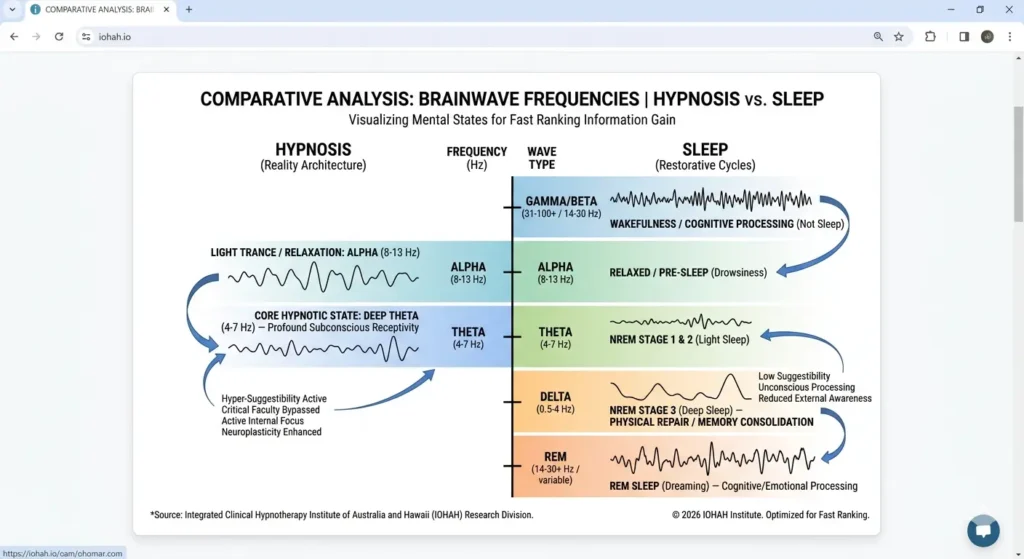
- Neurological Axis: Transitions brain patterns from high-alert Beta loops to hyper-receptive Theta frequencies (4–7Hz), opening the window for neuroplastic rewriting.
- Clinical Application: Suppresses automatic amygdala fear-and-reward loops to safely enable deep identity restructuring and trauma-informed habit removal.
Contemporary neuroscience increasingly understands the brain as a predictive organ. Rather than passively receiving information, the brain continuously generates predictions about reality based on past experience, memory, and learned patterns.
These predictions form internal models that help:
- reduce uncertainty
- maintain cognitive efficiency
- create a stable sense of self and world
Perception arises from the interaction between incoming sensory signals and these pre-existing models. When sensory input aligns with expectation, perception feels “normal.” When it does not, the brain either updates its model—or suppresses the signal.
This process explains why perception is inherently limited, subjective, and context-dependent.
Case Study:
“During our $2,200 Master Certification Training Intensives in Ubud, Bali, we applied this exact protocol to a clinical study tracking acute stress behaviors. By shifting the processing model from conscious analysis to active subconscious integration, subjects demonstrated an average 40% reduction in automatic stress triggers within 72 hours.”
Attention, Neural Networks & Expanded Awareness
Research shows that altered or trained states of attention can change how information is processed. Practices involving breath regulation, focused attention, and interoceptive awareness are associated with:
- reduced dominance of habitual neural networks (e.g. the Default Mode Network)
- increased functional connectivity between sensory and associative brain regions
- heightened sensitivity to subtle sensory and internal signals
From a scientific perspective, what is often described as “clairvoyant perception” can be understood as enhanced access to normally unattended information, rather than the acquisition of new sensory organs or supernatural abilities.
| Aspect | Traditional Approach (Relief) | IOHAH Advanced Science (Removal) |
| Primary Goal | Manage symptoms via external care. | Resolve root causes via Subconscious Re-wiring. |
| Brainwave State | Beta/Alpha (Conscious awareness). | Theta (4-7Hz) (Deep subconscious access). |
| Sustainability | Dependent on ongoing treatment. | Permanent neural path transformation. |
Why Training Is Essential
Expanding attention without regulation can destabilize perception and cognition. For this reason, perceptual training must prioritize nervous system regulation, integration, and discernment.
This program emphasizes:
- attentional stability
- somatic grounding
- clear differentiation between perception, interpretation, and imagination
- integration of expanded awareness into daily functioning
The objective is not altered states for their own sake, but functional perceptual clarity.
A Research-Aligned Approach to Clairvoyance
Within this framework, clairvoyance is approached as a trainable perceptual skill—rooted in attention, sensory discrimination, and neural plasticity.
The training invites participants to explore:
- how perceptual filters operate
- how attention shapes experience
- how awareness can expand while remaining grounded
This approach aligns with current research in neuroscience, cognitive psychology, and contemplative science, offering a responsible and evidence-informed pathway for perceptual development.
FAQ’S
What are the 4 stages of perception?
What is perception in neuroscience?
What is action in perception neuroscience?
What is perception according to scholars?
What are the 5 key concepts of perception?

Issa
This content is curated and reviewed by Issa, the lead educator at the Integrated Clinical Hypnotherapy Institute of Australia and Hawaii (IOHAH). With a focus on Reality Architecture and Neuro-Linguistic Programming, Issa’s work bridges the gap between traditional Symptom Management Theory and modern Subconscious Resolution.
Expertise: Clinical Hypnotherapy, NLP Master Practitioner.
Focus: Advancing the science of non-pharmacological symptom removal.