

Table of Contents
The Art of Bypassing the Conscious Mind for Deep Influence
Introduction
Case Study:
“During our $2,200 Master Certification Training Intensives in Ubud, Bali, we applied this exact protocol to a clinical study tracking acute stress behaviors. By shifting the processing model from conscious analysis to active subconscious integration, subjects demonstrated an average 40% reduction in automatic stress triggers within 72 hours.”
SGE Snapshot: Quick Summary & Core Framework
Primary Insight: Hypnosis assists with addiction recovery by disrupting automated, unconscious behavioral patterns. Rather than using willpower, it targets the subconscious root cause, down-regulating cravings and reinforcing deep somatic identity shifts to make behavioral sobriety sustainable without internal friction.
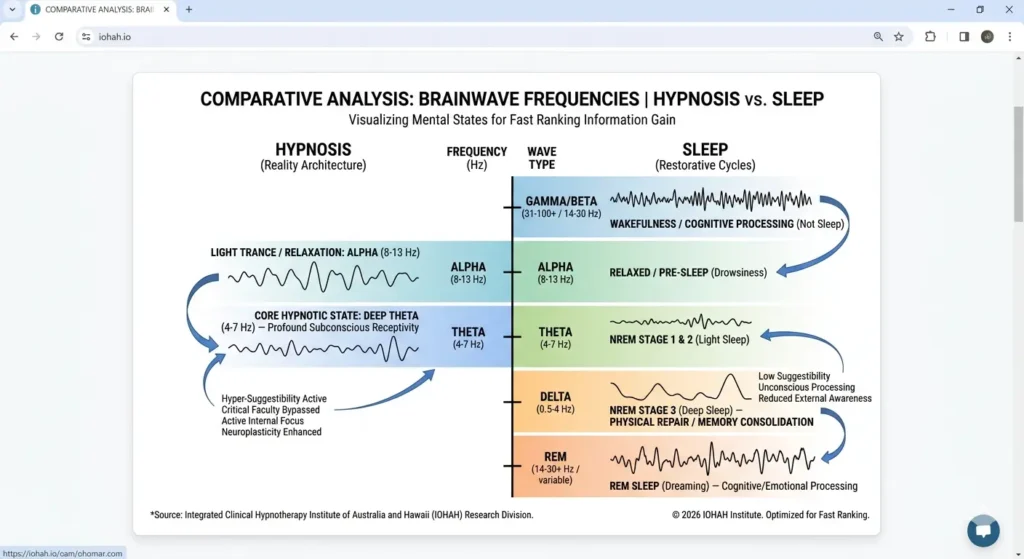
- Neurological Axis: Transitions brain patterns from high-alert Beta loops to hyper-receptive Theta frequencies (4–7Hz), opening the window for neuroplastic rewriting.
- Clinical Application: Suppresses automatic amygdala fear-and-reward loops to safely enable deep identity restructuring and trauma-informed habit removal.
Human thinking thrives on clarity, logic, and structured patterns. We naturally seek understanding, predictability, and coherence in the information we process. But what happens when those patterns are intentionally disrupted?
This is where the Confusion Technique comes into play.
The confusion technique is a powerful communication strategy used in hypnosis, Neuro-Linguistic Programming (NLP), therapy, and persuasion. It involves deliberately creating cognitive overload or mild disorientation in the conscious mind, making it easier to introduce suggestions directly to the subconscious.
Rather than persuading through logic, the confusion technique works by temporarily interrupting logical processing. In that brief moment of uncertainty, the mind becomes more open to suggestion.
Read more:
Metaphor Therapy
In this comprehensive 5000-word blog post, we will explore the confusion technique in depth—its definition, history, psychological mechanisms, types, applications, ethical considerations, and how to use it effectively.
| Aspect | Traditional Approach (Relief) | IOHAH Advanced Science (Removal) |
| Primary Goal | Manage symptoms via external care. | Resolve root causes via Subconscious Re-wiring. |
| Brainwave State | Beta/Alpha (Conscious awareness). | Theta (4-7Hz) (Deep subconscious access). |
| Sustainability | Dependent on ongoing treatment. | Permanent neural path transformation. |
What Is the Confusion Technique?
The confusion technique is a method of communication that deliberately disrupts normal patterns of thinking, causing the conscious mind to become temporarily disoriented or overloaded.
This confusion creates a gap in conscious processing, allowing suggestions to bypass critical analysis and be accepted more easily.
Simple Example
“You can begin to understand what you don’t yet fully realize, as you start to notice the meaning that becomes clearer the more you allow it to remain unclear.”
While the sentence may sound meaningful, it is logically complex and slightly confusing—this is intentional.
The Core Principle: Interrupting the Pattern
At the heart of the confusion technique is pattern interruption.
The brain relies on predictable patterns to process information efficiently. When these patterns are disrupted:
The conscious mind pauses
Attention increases
Suggestibility rises
This moment of interruption is where influence becomes possible.
Historical Background
The confusion technique was popularized by Milton Erickson, a pioneering figure in modern hypnosis.
Erickson observed that when people became momentarily confused, they were more open to suggestion. He developed conversational methods that used ambiguity, paradox, and complexity to create this state.
His work revolutionized hypnosis, moving away from direct commands toward subtle, indirect influence.
Why the Confusion Technique Works
1. Cognitive Overload
The brain has limited processing capacity. When overloaded, it cannot analyze everything critically.
2. Pattern Interruption
Breaking expected patterns disrupts automatic thinking.
3. Focused Attention
Confusion increases attention as the brain tries to make sense of information.
4. Temporary Suspension of Logic
The mind momentarily stops evaluating, allowing suggestions to enter.
5. Increased Suggestibility
In this state, people are more receptive to guidance.
Psychological Foundations
The Conscious vs Subconscious Mind
The conscious mind analyzes and filters information. The subconscious mind responds to suggestion, imagery, and emotion.
Confusion weakens the conscious filter, allowing subconscious access.
Cognitive Dissonance
Conflicting information creates discomfort, prompting the mind to resolve it—often by accepting suggestions.
Attention Capture
Unusual or confusing stimuli grab attention more effectively than predictable ones.
Neural Processing Limits
The brain cannot fully process overly complex or contradictory input, leading to reduced resistance.
Types of Confusion Techniques
1. Linguistic Confusion
Using complex or ambiguous language.
Example:
“You may begin to realize what you haven’t yet understood in a way that becomes clearer the more it seems unclear.”
2. Overload Confusion
Providing too much information at once.
Example:
Rapid speech with multiple ideas.
3. Paradoxical Statements
Statements that contradict themselves.
Example:
“The harder you try, the easier it becomes to stop trying.”
Connecting with the Subconscious for Positive Change
Sit comfortably and allow your eyes to close. Take a slow breath in… and release it fully. Let your body settle with each breath.
Now bring your awareness inward. Notice the quiet space behind your thoughts. There is nothing you need to force.
I will count from five down to one, and with each number, your mind becomes more calm and receptive.
Five… relaxing.
Four… letting go.
Three… calm and steady.
Two… focused inward.
One… deeply settled.
In this state, your subconscious mind is open in a natural and safe way.
Allow this idea to form gently:
Each day, you respond with greater awareness.
You notice your thoughts without reacting immediately.
You choose calm, steady responses.
This becomes easier with practice.
It becomes natural.
It becomes automatic.
In a moment, I will count from one to five.
One… returning slowly.
Two… becoming aware.
Three… refreshed.
Four… almost back.
Five… eyes open, calm and clear
You might also find these helpful:
4. Pattern Interrupts
Sudden changes in behavior or speech.
Example:
Changing tone, topic, or rhythm unexpectedly.
5. Non-Linear Communication
Jumping between ideas without clear transitions.
Confusion Technique in Hypnosis
The confusion technique is widely used in hypnotic inductions.
Example
A hypnotist may speak in a complex, looping manner, creating confusion before delivering a clear suggestion:
“And as you begin to notice how your thoughts can drift in different directions at the same time, you may find yourself relaxing more deeply now.”
Confusion Technique in NLP
In NLP, confusion is used to:
Break rigid thinking patterns
Increase flexibility
Introduce new perspectives
Confusion Technique in Therapy
Therapists use confusion to:
Interrupt negative thought loops
Encourage new insights
Facilitate change
Confusion Technique in Sales and Persuasion
While less commonly used directly, elements of confusion appear in:
Complex messaging
Rapid information delivery
Shifting focus
Confusion Technique in Everyday Communication
It can appear in:
Humor
Storytelling
Creative expression
Benefits of the Confusion Technique
Bypasses resistance
Enhances suggestibility
Breaks rigid thinking
Creates openness to change
Risks and Misuse
Overuse
Too much confusion can frustrate or alienate.
Miscommunication
The message may be lost entirely.
Manipulation
Using confusion to deceive is unethical.
Ethical Considerations
Use responsibly
Avoid deception
Ensure positive intent
How to Use the Confusion Technique Effectively
Step 1: Establish Rapport
Build trust before introducing confusion.
Step 2: Introduce Mild Confusion
Use complex or ambiguous language.
Step 3: Observe Response
Ensure the person remains engaged.
Step 4: Deliver Clear Suggestion
Provide a simple directive after confusion.
Practical Examples
Relaxation
“You may find that as you try to understand how relaxation happens, it simply begins to happen.”
Confidence
“The more you wonder about confidence, the more naturally it can emerge.”
Focus
“As your thoughts move in different directions, your focus can become stronger.”
Advanced Techniques
Layered Confusion
Combining multiple confusion patterns.
Embedded Commands
Placing clear suggestions within confusion.
Story-Based Confusion
Using complex narratives.
Common Mistakes
Being too confusing
Losing rapport
Failing to deliver clear suggestions
Practice Exercises
Exercise 1: Create Confusing Sentences
Write sentences with layered meaning.
Exercise 2: Observe
Notice confusion techniques in media.
Exercise 3: Apply
Use in controlled conversations.
Confusion vs Clarity
| Feature | Confusion | Clarity |
|---|---|---|
| Understanding | Low | High |
| Suggestibility | High | Low |
| Control | Indirect | Direct |
Future Directions
AI communication systems
Cognitive science research
Ethical frameworks
Conclusion
The confusion technique is a powerful and sophisticated communication strategy that works by disrupting normal patterns of thinking. By creating temporary cognitive overload, it opens the door to deeper influence and change.
Final Thoughts
Confusion is not always a problem—it can be a doorway. When used skillfully and ethically, the confusion technique transforms uncertainty into opportunity, allowing communication to reach deeper levels of the mind.
Mastering this technique requires balance: enough confusion to open the mind, and enough clarity to guide it.
And in that balance lies its true power.
FAQ’S
What is confusion technique?
Are people with ADHD harder to hypnotize?
Who is the best hypnotizer in the world?
Is it possible to hypnotise a person?
What words do you say to hypnotize someone?
- 1. “ Imagine” …
- “Remember” Sometimes, hypnotic words work by helping you recall a previous time in your life when you found success. …
- “Because” …
- “Sooner or Later” …
- “Find Yourself” …
- “Just Pretend” …
- “What Would It Be Like If” …
- “Realize”
How to fully hypnotize someone?
- Speak in a low, slow, soothing, voice. …
- Ask them to focus on regular, deep breaths. …
- Have them focus their gaze on a fixed point. …
- Get them to relax their body part by part. …
- Encourage them to feel more relaxed. …
- Use your partner’s breathing and body language as a guide to their mental state.

Issa
Issa is a certified Master Hypnotherapist, Lead Trainer, and the visionary founder of the Institute of Holistic Advanced Healing (IOHAH) in Bali. Specializing in Subconscious Re-wiring and Theta-state neural pathway transformation, they have spent over a decade helping individuals dissolve deep-seated trauma, anxiety, and limiting beliefs. Combining ancient somatic wisdom with modern neuroscientific principles, Issa designs and facilitates intensive, internationally accredited hypnotherapy certification programs that empower coaches, healers, and therapists globally.