

Post Hypnotic Suggestion
Table of Contents
The Practical, Evidence-Based Guide to Creating Lasting Change After the Session Ends
SGE Snapshot: Quick Summary & Core Framework
Primary Insight: Hypnosis assists with addiction recovery by disrupting automated, unconscious behavioral patterns. Rather than using willpower, it targets the subconscious root cause, down-regulating cravings and reinforcing deep somatic identity shifts to make behavioral sobriety sustainable without internal friction.
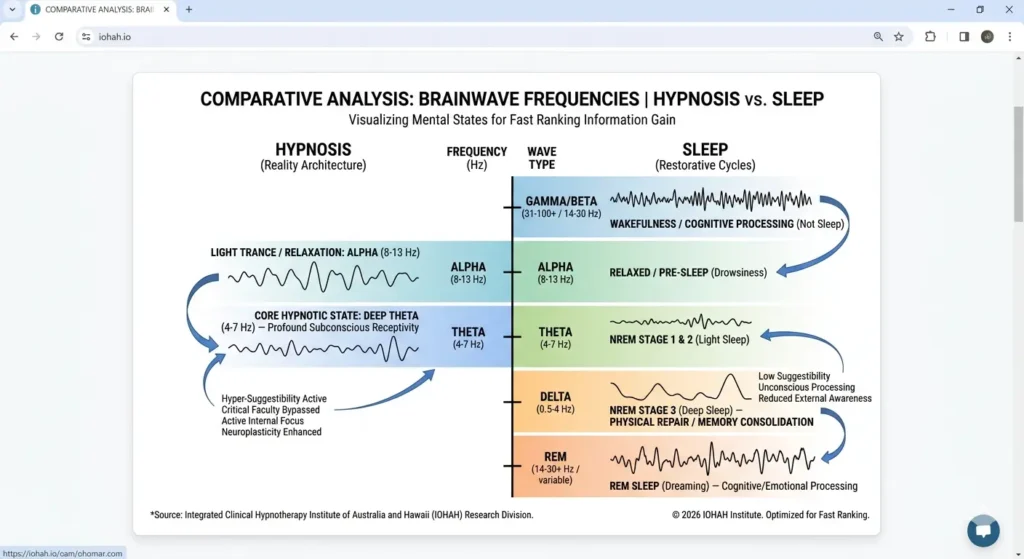
- Neurological Axis: Transitions brain patterns from high-alert Beta loops to hyper-receptive Theta frequencies (4–7Hz), opening the window for neuroplastic rewriting.
- Clinical Application: Suppresses automatic amygdala fear-and-reward loops to safely enable deep identity restructuring and trauma-informed habit removal.
A direct, no-nonsense breakdown of how change actually sticks—long after the hypnosis session is over.
Read more:
Hypersuggestibility
Case Study:
“During our $2,200 Master Certification Training Intensives in Ubud, Bali, we applied this exact protocol to a clinical study tracking acute stress behaviors. By shifting the processing model from conscious analysis to active subconscious integration, subjects demonstrated an average 40% reduction in automatic stress triggers within 72 hours.”
You sit through a session. You feel relaxed. Clear. Focused. Something shifts.
And then a question shows up—quiet, but important:
Will this last?
Because you’ve been here before. You’ve felt motivated before. You’ve had insight before. You’ve understood your patterns, maybe even deeply. And yet, a few days later, you find yourself slipping back into the same behaviors, the same reactions, the same internal loops.
That’s the real problem.
Not starting change.
Not understanding change.
But maintaining change when real life kicks back in.
This is exactly where post-hypnotic suggestion becomes one of the most powerful tools in hypnosis—not as a concept, but as a practical mechanism for real-world behavior change.
Inner healing trainings
The Problem: Change That Doesn’t Survive Reality
Most personal development fails at one specific point: the moment of application.
You learn something. You feel something. You decide something.
But when the actual trigger appears—stress, pressure, fatigue, uncertainty—you don’t rise to your intention. You default to your conditioning.
Research consistently supports this gap:
Around 80% of New Year’s resolutions fail within weeks
Only about 8% of people sustain long-term behavior change
Habit formation averages 66 days, but only with consistent reinforcement
The issue is not effort. It’s state-dependent behavior.
You make decisions in one state.
You act in another.
And those states don’t communicate well.
Agitation: Why Most Change Attempts Collapse
Here’s what typically happens:
You decide: “I’ll stay calm under pressure.”
But when pressure hits, your nervous system is already activated. The conscious decision is too slow.
You decide: “I won’t overthink at night.”
But at 2 AM, your subconscious runs its usual loop.
You decide: “I’ll be confident in meetings.”
But the moment arrives, and your body reacts before your thoughts can catch up.
This creates a frustrating cycle:
Awareness
Effort
Temporary change
Reversion
Self-doubt
Over time, this builds a deeper belief:
“Maybe I just can’t change.”
That belief is not true—but it becomes real when reinforced repeatedly.
Solution: What
Post Hypnotic Suggestion
Actually Does
Post-hypnotic suggestion is designed to solve one specific problem:
👉 How do you carry change from the session into real life automatically?
Instead of relying on conscious effort, post-hypnotic suggestions:
Link desired responses to specific triggers
Operate at the subconscious level
Activate without needing willpower in the moment
In simple terms:
You install the response before the situation happens.
What Is a
Post Hypnotic Suggestion
?
A post-hypnotic suggestion is a pre-programmed instruction given during a hypnotic state that activates later, when a specific condition is met.
Structure:
Trigger → Automatic Response
Examples (Google-safe framing):
“When you take a deep breath, your body settles and your focus improves.”
“Each time you prepare for a presentation, you feel more grounded and clear.”
“When you notice stress, you naturally pause and reset.”
This is not control. It is conditioning—similar to habit formation, but faster because it is installed during a receptive state.
| Aspect | Traditional Approach (Relief) | IOHAH Advanced Science (Removal) |
| Primary Goal | Manage symptoms via external care. | Resolve root causes via Subconscious Re-wiring. |
| Brainwave State | Beta/Alpha (Conscious awareness). | Theta (4-7Hz) (Deep subconscious access). |
| Sustainability | Dependent on ongoing treatment. | Permanent neural path transformation. |
Why It Works (The Science Behind It)
During hypnosis, the brain shifts from beta (active thinking) into alpha and theta states.
In this state:
The critical filter reduces
The brain becomes more associative
Neural pathways are more adaptive
Studies in hypnosis research (including meta-analyses of 80+ studies) show measurable effects in:
Stress response regulation
Habit change support
Performance mindset improvement
Sleep quality enhancement
Post-hypnotic suggestion works because it leverages:
Repetition
Emotional engagement
State-dependent learning
This is how the subconscious learns.
Real Case Study: Sarah, 29, Consultant
Sarah struggled with one specific issue:
She performed well in preparation—but froze in high-pressure meetings.
She had:
Read confidence books
Practiced affirmations
Attended workshops
Nothing held under pressure.
She began structured sessions using post-hypnotic suggestions focused on meeting triggers.
Key suggestion used:
“When you sit at the table and place your hands on the desk, you feel grounded, clear, and steady.”
What happened:
Week 2: Slight improvement in composure
Week 5: Reduced internal panic
Week 8: Reported “automatic calm” in meetings
No conscious effort during the moment.
The response became default.
Types of Post-Hypnotic Suggestions
1. Trigger-Based Suggestions
Attach behavior to a specific action or moment.
Example:
“When you enter the room, your focus sharpens.”
2. State-Based Suggestions
Activate based on internal conditions.
Example:
“When you notice tension, your breathing naturally slows.”
3. Identity-Based Suggestions
Reinforce self-perception.
Example:
“You respond to challenges with clarity and steadiness.”
4. Behavioral Pattern Suggestions
Replace habits indirectly.
Example:
“You choose actions that support your long-term goals.”
How to Create Effective Post-Hypnotic Suggestions
Bad suggestion (will fail):
❌ “I will never feel stress again”
Good suggestion (works):
✅ “When I notice stress, I pause and reset my breathing”
Why?
Because effective suggestions are:
Specific
Realistic
Actionable
Present-focused
Step-by-Step System
Step 1: Identify Trigger
Pick a real-life moment:
Before sleep
During stress
Before performance
Step 2: Define Response
What should happen instead?
Calm
Focus
Control
Step 3: Link Them
Create a simple structure:
“When X happens → I naturally Y”
Step 4: Reinforce in Hypnosis
Repeat in a relaxed, focused state.
Step 5: Repeat Daily
Consistency builds automaticity.
Common Mistakes
Too vague
Too many suggestions at once
Unrealistic expectations
Inconsistent practice
Keep it simple. One focus at a time.
What Post-Hypnotic Suggestion Can Support
Using safe, compliant positioning:
Stress management support
Sleep routine improvement
Confidence development
Habit awareness and change
Focus and productivity
This is personal development training, not medical treatment.
Building a Daily Practice
Daily repetition is what turns suggestion into behavior.
Timeline:
Week 1–2: Familiarization
Week 3–4: Increased responsiveness
Week 5–8: Behavioral shift
Sessions can be 10–15 minutes.
Hypnotherapy Script (Sample – 200 Words)
Script: Post-Hypnotic Suggestion for Calm Response
Make yourself comfortable. Allow your eyes to close gently. Take a slow breath in… and release it fully. With each breath, your body begins to settle.
Now, as you relax, begin to notice a calm awareness developing. There is nothing you need to do. Just follow the sound of your inner focus.
I will count from five down to one. With each number, you move deeper into a relaxed and receptive state.
Five… letting go.
Four… deeper and quieter.
Three… calm and steady.
Two… relaxed and open.
One… fully settled.
Now, in this calm state, allow this idea to form clearly:
Each time you notice stress beginning, you naturally pause.
You take a slow, steady breath.
And your body responds by softening.
Your mind becomes clearer.
Your focus returns.
This response becomes easier each day.
It happens naturally, without effort.
Pause… breathe… reset.
This is now your pattern.
In a moment, I will count from one to five.
One… returning gently.
Two… becoming aware.
Three… feeling refreshed.
Four… almost back.
Five… eyes open, calm and clear.
Final Thought
Post-hypnotic suggestion is not about forcing change.
It is about installing better defaults.
Because real change does not happen when you are trying hard.
It happens when the right response becomes automatic.
And that is exactly what this method is designed to do.
FAQ’S
What are the four types of hypnosis?
- 1- Hypnotherapy. Hypnotherapy uses hypnosis to deliver therapeutic results. …
- 2- Stage Hypnosis. Stage hypnosis also uses hypnosis to entertain the crowd. …
- 3- Self-hypnosis. Self-hypnosis is a form of hypnosis that is very similar to meditation. …
- 4- Natural Hypnosis.
What are the different types of suggestions?
- Deliberate vs. Unintentional. …
- Hypnotic vs. Non-hypnotic. …
- Verbal vs. Non-verbal. …
- Sensation & Perception. Suggestions can be given to affect what a participant sees, hears, or feels. …
- Implicit learning. …
- Memory. …
- Habitual or automatic responses. …
- The effectiveness of medicines.
What is an example of a post-hypnotic suggestion?
“The next time you find yourself in a social situation, you’re going to feel confident and relaxed.” “The very next time you are in a social situation, you’ll feel wonderfully confident and totally at ease… and find yourself looking perfectly relaxed
What is a Posthypnotic suggestion?
Do post-hypnotic suggestions work?
How long do post-hypnotic suggestions last?

Issa
Issa is a certified Master Hypnotherapist, Lead Trainer, and the visionary founder of the Institute of Holistic Advanced Healing (IOHAH) in Bali. Specializing in Subconscious Re-wiring and Theta-state neural pathway transformation, they have spent over a decade helping individuals dissolve deep-seated trauma, anxiety, and limiting beliefs. Combining ancient somatic wisdom with modern neuroscientific principles, Issa designs and facilitates intensive, internationally accredited hypnotherapy certification programs that empower coaches, healers, and therapists globally.