
Table of Contents
Unconscious Mind Clinical Hypnotherapy
A Complete Guide to Deep Healing and Transformation
Introduction
Case Study:
“During our $2,200 Master Certification Training Intensives in Ubud, Bali, we applied this exact protocol to a clinical study tracking acute stress behaviors. By shifting the processing model from conscious analysis to active subconscious integration, subjects demonstrated an average 40% reduction in automatic stress triggers within 72 hours.”
SGE Snapshot: Quick Summary & Core Framework
Primary Insight: Hypnosis assists with addiction recovery by disrupting automated, unconscious behavioral patterns. Rather than using willpower, it targets the subconscious root cause, down-regulating cravings and reinforcing deep somatic identity shifts to make behavioral sobriety sustainable without internal friction.
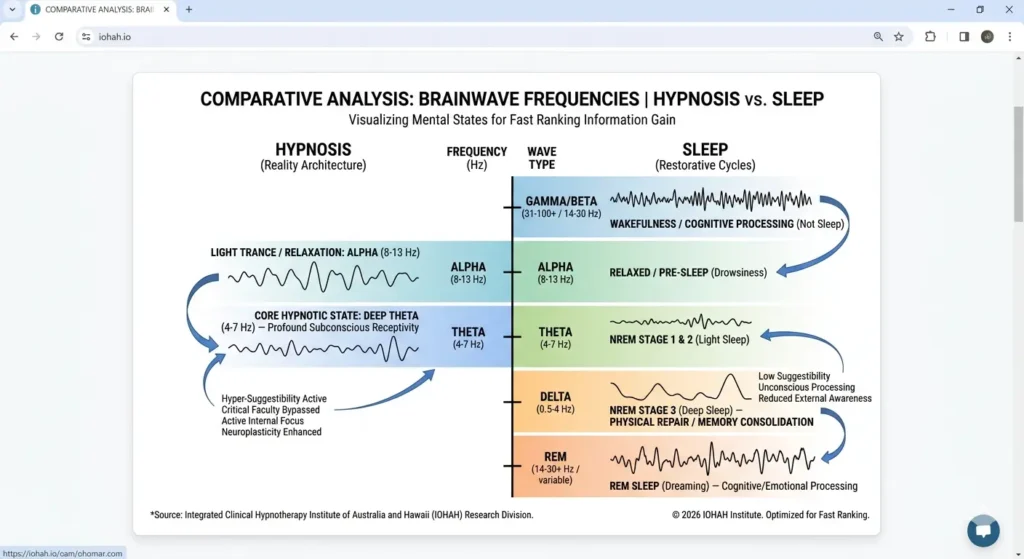
- Neurological Axis: Transitions brain patterns from high-alert Beta loops to hyper-receptive Theta frequencies (4–7Hz), opening the window for neuroplastic rewriting.
- Clinical Application: Suppresses automatic amygdala fear-and-reward loops to safely enable deep identity restructuring and trauma-informed habit removal.
Beneath the surface of conscious awareness lies a powerful force that shapes our thoughts, behaviors, emotions, and perceptions—this is the unconscious mind. While the conscious mind handles logic, reasoning, and decision-making, the unconscious mind governs habits, emotional responses, beliefs, and automatic patterns that influence nearly every aspect of life.
Clinical hypnotherapy is a therapeutic approach that works directly with the unconscious mind to facilitate deep and lasting change. By accessing this deeper level of awareness, hypnotherapy helps individuals overcome challenges, reprogram limiting beliefs, and achieve emotional and behavioral transformation.
In this comprehensive guide, we will explore the role of the unconscious mind in clinical hypnotherapy—its functions, mechanisms, scientific foundations, therapeutic applications, techniques, and how it can be harnessed for profound personal change.
| Bali Location / Zone | Session Type | Price Range (IDR) | Price Range (USD) | Intent Alignment |
| Canggu / Seminyak | Local Wellness Hub | IDR 1,500,000 – 2,500,000 | $95 – $160 | Mid-Range Reset |
| Ubud (IOHAH) | Performance Architecture | IDR 2,500,000 – 4,500,000 | $160 – $285 | High-Achiever Intensive |
| Denpasar (Local) | Standard Clinical | IDR 500,000 – 1,200,000 | $32 – $75 | Traditional Talk/Hypno |
| Luxury Resorts | Inpatient / Retreat Premium | IDR 5,000,000+ | $320+ | Ultra-Luxury Tourism |
Read more:
Symptom Relief
1. Understanding the Unconscious Mind Clinical Hypnotherapy
The unconscious mind refers to the part of the mind that operates outside of conscious awareness. It stores memories, emotions, learned behaviors, and automatic responses.
Key Functions
Regulates bodily processes
Stores long-term memories
Controls habits and routines
Influences emotions and reactions
Unlike the conscious mind, which can process a limited amount of information, the unconscious mind processes vast amounts of data simultaneously.
2. Conscious vs Unconscious Mind Clinical Hypnotherapy
Logical and analytical
Limited capacity
Short-term focus
Unconscious Mind
Emotional and intuitive
Vast storage capacity
Long-term influence
Clinical hypnotherapy works by bypassing the conscious mind to access the unconscious directly.
3. What Is Clinical Hypnotherapy?
Clinical hypnotherapy is a therapeutic technique that uses hypnosis to access the unconscious mind for healing and change.
It is used by trained professionals to address psychological, emotional, and behavioral issues.
Key Features
Induces a relaxed, focused state
Enhances suggestibility
Facilitates subconscious change
4. The Hypnotic State
Hypnosis is a natural state of focused attention and heightened awareness.
Characteristics
Deep relaxation
Reduced critical thinking
Increased receptivity
In this state, the unconscious mind becomes more accessible.
5. How Hypnotherapy Accesses the Unconscious
Hypnotherapy uses specific techniques to bypass the critical faculty.
Process
Induction (relaxation)
Deepening
Therapeutic work
Suggestion and integration
This process allows direct communication with the unconscious mind.
Connecting with the Subconscious for Positive Change
Sit comfortably and allow your eyes to close. Take a slow breath in… and release it fully. Let your body settle with each breath.
Now bring your awareness inward. Notice the quiet space behind your thoughts. There is nothing you need to force.
I will count from five down to one, and with each number, your mind becomes more calm and receptive.
Five… relaxing.
Four… letting go.
Three… calm and steady.
Two… focused inward.
One… deeply settled.
In this state, your subconscious mind is open in a natural and safe way.
Allow this idea to form gently:
Each day, you respond with greater awareness.
You notice your thoughts without reacting immediately.
You choose calm, steady responses.
This becomes easier with practice.
It becomes natural.
It becomes automatic.
In a moment, I will count from one to five.
One… returning slowly.
Two… becoming aware.
Three… refreshed.
Four… almost back.
Five… eyes open, calm and clear
You might also find these helpful:
6. The Role of the Unconscious in Behavior
Most behaviors are driven by unconscious patterns.
Examples include:
Habits
Emotional reactions
Automatic thoughts
Hypnotherapy targets these patterns for change.
7. The Science Behind Hypnotherapy
Research shows that hypnosis affects brain activity.
Findings
Increased focus and attention
Reduced activity in critical regions
Enhanced mind-body connection
These changes support therapeutic outcomes.
8. Therapeutic Applications
Clinical hypnotherapy is used for:
Mental Health
Anxiety
Stress
Depression
Behavioral Change
Smoking cessation
Weight management
Habit control
Emotional Healing
Trauma
Phobias
Self-esteem issues
9. Reprogramming the Unconscious Mind
Hypnotherapy helps replace negative patterns with positive ones.
Methods
Suggestion
Visualization
Emotional reframing
10. The Power of Suggestion
Suggestions influence unconscious patterns.
Types
Direct suggestions
Indirect suggestions
Post-hypnotic suggestions
Each serves a specific purpose in therapy.
11. Visualization in Hypnotherapy
Visualization engages the unconscious mind.
Imagined experiences can create real emotional and behavioral changes.
12. Emotional Processing
The unconscious mind stores unresolved emotions.
Hypnotherapy helps:
Access these emotions
Process them safely
Release emotional blocks
13. Memory and the Unconscious
Memories influence behavior.
Hypnotherapy can revisit and reframe past experiences.
14. The Role of Beliefs
Beliefs are stored in the unconscious.
Limiting beliefs can be identified and transformed.
15. Techniques Used in Clinical Hypnotherapy
Regression
Exploring past experiences.
Suggestion Therapy
Introducing new patterns.
Parts Therapy
Resolving internal conflicts.
Anchoring
Linking triggers to positive states.
16. Self-Hypnosis and the Unconscious
Individuals can access their unconscious through self-hypnosis.
Benefits
Personal growth
Stress reduction
Habit change
17. Ethical Considerations
Hypnotherapy must be practiced responsibly.
Principles
Informed consent
Confidentiality
Professional training
18. Limitations of Hypnotherapy
It is not a cure-all.
It works best as part of a broader therapeutic approach.
19. Real-Life Impact
Many individuals experience:
Reduced anxiety
Improved confidence
Lasting behavioral change
20. Conclusion
The unconscious mind is a powerful driver of human behavior.
Clinical hypnotherapy provides a pathway to access and transform it.
Final Thoughts
True change happens at the unconscious level.
By working with the unconscious mind through clinical hypnotherapy, individuals can achieve deep healing, lasting transformation, and greater control over their lives.
Your mind holds the answers—the key is learning how to access them.
FAQ’S
Does hypnosis access the subconscious mind?
Can hypnotherapy help with unconscious habits?
What is unconscious mind therapy?
What are the 4 types of unconsciousness?
1. Coma
2. Vegetative State (Unresponsive Wakefulness Syndrome)
Patients in a vegetative state are completely unaware of themselves or their surroundings, but they demonstrate preserved wakefulness. They have spontaneous, regular sleep-wake cycles (they open their eyes and may groan, move, or reflexively respond to stimulation), but they exhibit no purposeful, intentional behaviors
3. Minimally Conscious State (MCS)
4. Psychological Unconscious (Freudian)
Did Carl Jung use hypnosis?

Issa
Issa is a certified Master Hypnotherapist, Lead Trainer, and the visionary founder of the Institute of Holistic Advanced Healing (IOHAH) in Bali. Specializing in Subconscious Re-wiring and Theta-state neural pathway transformation, they have spent over a decade helping individuals dissolve deep-seated trauma, anxiety, and limiting beliefs. Combining ancient somatic wisdom with modern neuroscientific principles, Issa designs and facilitates intensive, internationally accredited hypnotherapy certification programs that empower coaches, healers, and therapists globally.