

Relaxation and Focus Techniques for Students
Table of Contents
How to Study Smarter, Stress Less, and Actually Retain What You Learn
A practical, research-backed guide for students who are working hard but getting less out of every hour than they deserve.
Read more:
Hypnotherapy Sessions Before Exams
You have been sitting at your desk for two hours. The textbook is open in front of you. The notes are out. The highlighter is in your hand. And you have read the same paragraph five times without a single word actually landing in your brain.
Read more:
Natural Delivery Hypnosis in bali 2026
Overcoming Procrastination Before Exams
If that scenario is familiar, you are not lazy. You are not unintelligent. You are not cut out for a different career. You are simply a student operating in a state that makes genuine learning almost impossible, and nobody ever taught you how to get out of it.
The ability to relax deeply and focus clearly are two of the most important academic skills a student can develop. They are also two of the most neglected. Schools teach content. Teachers cover the curriculum. Tutors explain concepts. But almost nobody sits a student down and says: here is how your brain actually works, here is what it needs to absorb information effectively, and here are the specific relaxation and focus techniques for students that will help you get there.
Relaxation and Focus Techniques for Students
This blog fills that gap. We are going to look honestly at what chronic stress and chronic distraction are doing to student performance, why the instinctive responses to those problems make everything worse, and then walk through six practical, evidence-backed concentration techniques for students that you can start using today. We will also cover how hypnotherapy fits into a broader student relaxation and focus program, and what the research actually says about all of it.
No vague advice. No motivational platitudes. Just direct, useful information that respects your intelligence and your time.
The Student Attention and Stress Crisis Nobody Talks About
Student stress is not a new problem. Exams have always been stressful. Deadlines have always created pressure. But something has shifted significantly in the past decade, and the data reflects it in ways that should concern anyone involved in education.
According to the American Institute of Stress, approximately 80 percent of college students report feeling frequently overwhelmed by the demands of their studies. A 2022 survey by the American College Health Association found that 63 percent of college students met the criteria for overwhelming anxiety in the previous twelve months, and over half reported that stress had negatively affected their academic performance. These are not fringe statistics. They describe the majority of students sitting in classrooms and lecture halls right now.
| Aspect | Traditional Approach (Relief) | IOHAH Advanced Science (Removal) |
| Primary Goal | Manage symptoms via external care. | Resolve root causes via Subconscious Re-wiring. |
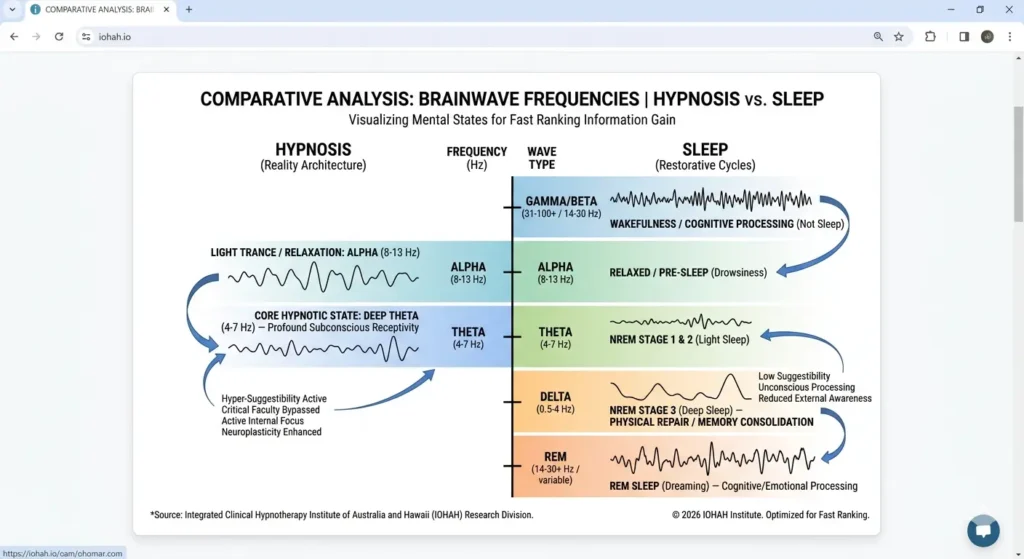
| Brainwave State | Beta/Alpha (Conscious awareness). | Theta (4-7Hz) (Deep subconscious access). |
| Sustainability | Dependent on ongoing treatment. | Permanent neural path transformation. |
Relaxation and Focus Techniques for Students
The attention side of the crisis is equally serious. A study from the University of California, Irvine found that it takes an average of 23 minutes for a person to regain full concentration after a significant interruption. In a typical student study session, interruptions from phones, social media, and notifications happen every three to five minutes. The math on that is brutal. Many students spend an entire study session never actually reaching a state of deep, productive focus at all.
The result is a generation of students who are technically studying for long hours but absorbing far less than those hours should produce. They are exhausted, overwhelmed, and frustrated, and they have no framework for understanding why things are not clicking the way they should.
Your Brain on Chronic Stress
To understand why relaxation techniques for students are not a soft optional extra but a hard academic necessity, you need to understand what sustained stress actually does to the learning brain.
Short-term, acute stress can actually sharpen attention and improve performance on certain tasks. The kind of mild pressure you feel walking into an exam you feel prepared for can help you focus and retrieve information quickly. That is the stress response working the way it is designed to work.
Chronic stress is an entirely different animal. When cortisol levels remain elevated for days, weeks, or months at a time, which is the reality for most students during an academic semester, the effects on the brain are well-documented and uniformly negative for learning.
The hippocampus, the brain region most directly involved in forming new memories and encoding new information, is particularly vulnerable to sustained cortisol exposure. Research from the Rockefeller University found that chronic stress literally reduces the number of synaptic connections in the prefrontal cortex and hippocampus. In practical terms, this means that a student who is chronically stressed is attempting to study with a brain that is structurally less capable of forming the memories they need. Reading the same page three times and retaining nothing is not a focus problem in isolation. It is a neurological symptom of an overstressed brain.
The prefrontal cortex, which handles planning, reasoning, and the kind of high-order thinking that academic performance requires, is also directly compromised by chronic stress. Students describe this as their brain feeling foggy, slow, or unresponsive. That is not a metaphor. It is an accurate description of prefrontal cortex function under elevated cortisol conditions.
The only way to restore the brain’s capacity for learning is to give it the recovery conditions it needs. That means genuine relaxation, not just passive scrolling on a phone, but actual neurological downtime. This is what deep relaxation for studying makes possible.
Related Research Modules
Accelerated Language Learning:
Affect Bridge Clinical Hypnotherapy
Alpha State Clinical Hypnotherapy
Analgesia Clinical Hypnotherapy
The Distraction Economy and the Student Brain
The stress problem does not exist in isolation. It is compounded by a distraction problem that is, in many ways, deliberately engineered.
The apps on your phone are designed by some of the most sophisticated behavioral engineering teams in the world. Their explicit goal is to capture your attention and hold it for as long as possible. Every notification, every infinite scroll, every variable reward mechanism is calibrated to make it as difficult as possible for you to direct your attention elsewhere. For a student trying to develop the skill of sustained concentration, that is a formidable opponent.
Research from Microsoft found that the average human attention span in digitally saturated environments has dropped from approximately twelve seconds in 2000 to around eight seconds by 2015. While that specific statistic has been debated, the broader pattern is well-supported: habitual digital distraction trains the brain toward shallower, more fragmented attention patterns over time. Deep focus, the sustained, concentrated engagement that produces genuine understanding and long-term memory encoding, does not come naturally to a brain that has been rewarded for constant context-switching.
This is not a moral failing in students. It is a conditioned neurological response to an environment that incentivizes distraction. The good news is that attention, like any trainable skill, can be rebuilt with the right focus techniques for students and consistent practice.
What Happens When Students Never Learn to Relax or Focus
Let us be direct about where this goes if nothing changes. The short-term cost of poor student stress relief and weak focus is lower marks than your effort deserves. The medium-term cost is burnout. The long-term cost goes well beyond grades.
Burnout among university students is at a historically high level. A 2021 study published in the journal Frontiers in Psychology found that approximately 40 percent of university students showed significant burnout symptoms, with emotional exhaustion being the dominant feature. Burnout does not just mean feeling tired. It means a fundamental depletion of the mental and emotional resources that make studying, engaging with ideas, and pursuing goals possible.
Students who burn out mid-semester often face a compounding crisis. They fall behind on coursework, which creates more stress, which deepens the exhaustion, which makes catching up harder. The academic consequences range from a single poor grade to full withdrawal from programs that students were genuinely capable of completing. Every one of those students had, at some point before burnout hit, been working hard and trying their best. The problem was never effort. The problem was the absence of the recovery skills and focus techniques that would have made their effort sustainable.
There are physical health costs, too. Chronic stress is associated with disrupted sleep, weakened immune function, digestive problems, and increased vulnerability to anxiety and depression. Students who never develop effective relaxation skills are not just underperforming academically. They are paying for that gap with their health.
The Productivity Trap
When students recognize they are falling behind or underperforming, the almost universal response is to study more. Add more hours. Stay up later. Skip the gym, skip the social time, skip the rest. Grind harder until things improve.
This feels responsible. It feels like the right answer. It is, for most students already operating in a stressed and distracted state, exactly the wrong answer.
The research on cognitive performance and working hours is unambiguous. Beyond a certain threshold, additional study hours produce diminishing returns that decline rapidly. A study from Stanford University found that productivity per hour drops sharply after fifty hours of cognitively demanding work per week, and falls off a cliff beyond fifty-five hours. For students, this means that the student putting in twelve-hour study days during exam week is likely getting dramatically less learning per hour in hours nine through twelve than they were in hours one through four.
The multitasking myth compounds this problem. Many students believe they are being productive by studying while monitoring their phone, watching a video in a background tab, or responding to messages between paragraphs. Neuroscience has been clear on this for over a decade: multitasking does not exist. What the brain actually does is rapid task-switching, and every switch carries a cognitive cost. A study from the University of London found that habitual multitasking during cognitive tasks produced IQ drops comparable to missing a full night of sleep. You cannot multitask your way to better study focus. You focus, or you do not.
The productivity trap is real, and it catches some of the most motivated students. The harder they try using the wrong approach, the worse their results get, which drives them to try even harder using the same broken approach. Breaking out of that cycle starts with understanding that rest, recovery, and focused attention are not the opposite of productive studying. They are the foundation of it.
A Real Student Story: Priya, 20, Engineering Student
Priya was a second-year civil engineering student at a large urban university. She was the kind of student her professors described as conscientious: always at lectures, always submitting on time, always putting in the work. By her own estimate, she was studying between nine and eleven hours a day during her second semester, and she was getting seven hours of broken sleep most nights.
Her mid-semester results were a shock. Despite the volume of effort she was putting in, her grades in two core modules had dropped compared to her first semester. She was spending more time studying and performing worse. The explanation made no sense to her, which made the anxiety worse. She started adding more hours, cutting back further on sleep, and canceling the twice-weekly runs that had previously been her main outlet.
By week ten of the semester, Priya was in full burnout. She described sitting at her desk and feeling empty, as if the information she was reading was landing on glass rather than going in. She had headaches most days, she was catching every cold that went through the student residence, and she had started dreading going to lectures, something that had never happened in her first year.
The turning point came during a conversation with a university wellbeing advisor who introduced Priya to the concept of study recovery and structured relaxation as academic tools, not luxuries. Over the following three weeks, Priya rebuilt her schedule around the Pomodoro method, reinstated her runs, adopted a twenty-minute progressive muscle relaxation session after dinner, and began a consistent seven to eight-hour sleep routine. She also worked with a counselor who used hypnotherapy for student stress as a mindset support component of her personal development program.
Her end-of-semester results: both modules she had been struggling with came back above her first-semester averages. She was studying fewer hours and absorbing more. She described the difference as going from pushing against a locked door to walking through an open one.
Priya’s story is not an outlier. It is a very common pattern, and the techniques that helped her are available to any student willing to apply them consistently.
The Foundation: Understanding What Relaxation Actually Does
Before we get into the specific techniques, there is a mindset shift that needs to happen, because without it, students tend to apply these techniques halfheartedly and then abandon them.
Relaxation is not the opposite of studying. It is a biological requirement for studying to work.
When you are in a state of genuine relaxation, your brain activates what neuroscientists call the default mode network. This network, which operates when you are at rest rather than actively focused on a task, plays a critical role in memory consolidation, creative problem solving, and the integration of new information with existing knowledge. Some of the most important learning your brain does happens not while you are staring at a textbook, but during the periods of genuine rest that follow your study sessions.
This is not an excuse to stop studying. It is an evidence-based argument for structuring your study time to include deliberate recovery periods, because those recovery periods are when a significant portion of the actual learning consolidation takes place.
Deep relaxation for studying is, therefore, not something you do instead of studying. It is something you do to make studying productive in the first place. With that framing established, let us look at the techniques themselves.
Relaxation and Focus Techniques for Students
These six techniques are drawn from cognitive behavioral research, sports psychology, neuroscience, and mindfulness practice. Each one addresses a specific aspect of the student focus and relaxation challenge. They are designed to work together as a system, but each is also independently useful and can be adopted one at a time.
Technique 1: The Pomodoro Method, Done Properly
Most students have heard of the Pomodoro technique. Far fewer actually use it correctly, and the difference between correct and incorrect application is the difference between a technique that genuinely transforms your study focus and one that just adds a timer to the same ineffective habits.
The Pomodoro method was developed by Francesco Cirillo in the late 1980s and is named after the tomato-shaped kitchen timer he used as a university student. The structure is simple: twenty-five minutes of completely uninterrupted focused work, followed by a five-minute break. After four cycles, take a longer break of fifteen to thirty minutes. The total structure of one full Pomodoro set is approximately two hours, covering roughly one hundred minutes of actual focused work.
The reason this works comes down to two things. First, it makes focus a time-bounded sprint rather than an open-ended endurance effort. Most students find the idea of concentrating for four hours daunting to the point of avoidance. Concentrating for twenty-five minutes is manageable. The psychological shift is significant. Second, the structured breaks are not optional add-ons. They are the mechanism that allows the prefrontal cortex to recover and sustain performance across multiple sessions.
Here is what doing it properly looks like in practice:
- Before each twenty-five-minute session, write down the single specific task you are working on. Not studying biochemistry. Something like: complete practice questions 14 through 22 in chapter six.
- Put your phone in another room or use an app blocker for the duration. Not face-down on the desk. Out of the room.
- During the five-minute break, stand up and move. Get water. Look out a window. Do not check your phone in the first three Pomodoros, as doing so reactivates the distraction loop and significantly reduces the recovery value of the break.
- Use the longer break after four cycles for genuine rest: a short walk, food, a brief mindfulness practice, or simply sitting quietly without screens.
Students who apply the Pomodoro method correctly consistently report that they accomplish more in four focused Pomodoros than they previously did in six or seven hours of distracted, open-ended studying. The technique works because it respects both how the brain focuses and how it recovers.
Technique 2: Progressive Muscle Relaxation for Study Recovery
Progressive Muscle Relaxation, commonly called PMR, was developed by American physician Edmund Jacobson in the 1920s and has been rigorously studied for nearly a century. It remains one of the most evidence-supported relaxation interventions available, and it is particularly well-suited to student stress relief because it directly addresses the physical component of tension that most students carry without realizing it.
The technique involves systematically tensing and then releasing different muscle groups throughout the body, working progressively from feet to head. The deliberate contrast between tension and release teaches the nervous system to recognize and deepen the relaxation response. Over time and with regular practice, the body becomes much more responsive to relaxation cues, meaning you can reach a genuinely restful physiological state much more quickly.
For students, the most practical application is a ten to fifteen-minute PMR session after a study block, ideally in the evening before transitioning away from academic work. Here is the basic protocol:
- Lie down or sit in a comfortable chair. Close your eyes and take three slow, deep breaths.
- Starting with your feet, tense the muscles firmly for five seconds, then release completely for fifteen to twenty seconds. Notice the contrast between the tension and the release.
- Work upward through calves, thighs, abdomen, hands, forearms, upper arms, shoulders, neck, and face. Each muscle group gets the same tense-and-release cycle.
- End with three more slow breaths, and take a moment before standing up.
A 2019 meta-analysis in the Journal of Behavioral Medicine found that PMR produced significant reductions in both perceived stress and physiological stress markers, including cortisol levels. For students, regular PMR practice is one of the most direct ways to interrupt the chronic stress cycle that degrades memory formation and concentration capacity.
Technique 3: Mindful Breathing to Reset Focus Mid-Study
Mindfulness for students does not require a meditation cushion, a quiet room, or thirty minutes of free time. In its most practical, immediately applicable form, mindful breathing is a two-to-five-minute reset tool that you can use at your desk, in a library, or anywhere you notice your concentration starting to drift.
The mechanism here is straightforward. When your mind wanders during study, which it inevitably will, you are operating in a state of unfocused, default-mode rumination rather than directed attention. Mindful breathing gives your attentional system a specific, neutral object to anchor on, your breath, which interrupts the wandering and allows you to consciously redirect your focus back to the task at hand.
The practice is simple. When you notice your focus has drifted or you feel your concentration slipping:
- Stop what you are doing. Do not fight the distraction. Simply pause.
- Take one slow breath in through your nose, counting to four. Hold briefly. Exhale slowly through your mouth, counting to six.
- Repeat three to five times, keeping your attention entirely on the physical sensation of breathing.
- Before returning to your study material, take a moment to consciously re-anchor yourself to your task. What are you working on? What is the next specific thing you need to do?
Research from Harvard Medical School found that even brief mindfulness practices of this kind produce measurable reductions in mind-wandering and improvements in sustained attention within just a few weeks of consistent use. It is a genuine concentration technique for students that requires zero equipment and almost no time, but delivers real, compounding benefits when practiced regularly.
Technique 4: The Focus Environment Protocol
Your environment does not just affect how comfortable you are while studying. It actively shapes your neurological state. Understanding this allows you to deliberately engineer an environment that supports focus rather than working against it.
This is one of the most practical and immediately effective study focus tips available, because it removes obstacles before they become problems rather than requiring willpower to overcome them in the moment.
Here is what an intentional focus environment looks like:
- Phone management: The phone does not sit on your desk during focused study sessions. Research from the University of Texas at Austin found that the mere presence of a smartphone on a desk, even face-down and silent, reduced available cognitive capacity in measurable ways. The phone needs to be physically out of reach, ideally in another room.
- Noise: This is highly individual. Some students focus better in complete silence. Others find that low-level ambient sound, such as coffee shop noise or instrumental music without lyrics, helps maintain focus by providing a neutral acoustic background that prevents the brain from scanning the environment for novel sounds. Experiment to find what works for you, but lyrics in songs are almost universally disruptive during reading and writing tasks.
- Lighting: Natural light is strongly associated with higher alertness and better mood. If you can study near a window, do. If you are studying at night, warm artificial lighting is less disruptive to your circadian rhythm than harsh blue-spectrum lighting.
- Desk organization: A cluttered visual environment creates low-level cognitive noise. Before each study session, take two minutes to clear your workspace to contain only what you need for that specific session.
- A cue to start: Some students find it helpful to have a consistent physical cue that signals the beginning of a focused work period. This might be making a specific drink, putting on headphones, or doing thirty seconds of breathing. The ritual builds a conditioned response: when I do this, I focus.
Environmental design is not about finding perfect conditions. It is about stacking the deck in your favor so that focus becomes the path of least resistance rather than a constant uphill battle.
Technique 5: Body Scan Relaxation for Pre-Study Preparation
Most students sit down to study while still carrying the mental and physical residue of everything that came before: a stressful conversation, a difficult commute, background worry about an upcoming deadline. That residual tension does not disappear because you opened a textbook. It sits in your body and your mind, competing with the material you are trying to absorb.
A body scan is a mindfulness-based practice that allows you to systematically release that residual tension before a study session begins, so that you actually start in a clear, receptive state rather than a distracted, tense one. Unlike Progressive Muscle Relaxation, which involves deliberate tensing and releasing, a body scan is purely attentional: you direct your awareness slowly through different parts of your body, noticing sensation without trying to change it, and allowing tension to release naturally as you attend to each area.
A practical pre-study body scan takes about eight to ten minutes:
- Sit comfortably in your study chair, feet flat on the floor. Close your eyes and take three slow, full breaths.
- Bring your attention to the top of your head. Simply notice any sensation there without judgment. Slowly move your attention down through your face, jaw, neck, and shoulders.
- Continue downward through your chest, stomach, lower back, hips, and legs, all the way to your feet. Wherever you notice tension, simply breathe into that area and allow it to soften on the exhale.
- When you reach your feet, take one final slow breath, open your eyes, and begin your study session from that calmer, more grounded baseline.
This technique is particularly effective for students who struggle with how to concentrate while studying because they arrive at their desk in an already-activated, anxious state. The body scan creates a genuine neurological transition between whatever came before and the focused work ahead.
Technique 6: The Study Shutdown Ritual
One of the most underappreciated contributors to student stress and poor sleep is the absence of a clear psychological boundary between study time and rest time. When students have no formal ending point to their academic day, the mind continues to process, worry about, and mentally rehearse study content and academic obligations well into the evening, disrupting sleep quality and preventing the genuine recovery that nighttime is supposed to provide.
A study shutdown ritual is a brief, consistent sequence of actions performed at the end of each study day that explicitly closes the academic loop and signals to the brain that work is done. Psychologist Cal Newport, who has written extensively on deep work and study strategies, advocates for this approach as a critical component of sustainable high-performance studying.
An effective study shutdown ritual typically includes the following elements:
- Review what you accomplished during the day’s study sessions. Note it briefly in a journal or planner. This serves two purposes: it provides evidence for the self-critical brain that you actually did productive work, and it creates a record you can review when anxiety tells you that you are behind.
- Write down any outstanding tasks or concerns for tomorrow. Getting them out of your head and onto paper reduces the mental load your brain carries into the evening. Research by psychologists Baumeister and Masicampo found that simply writing down unfinished tasks, along with a plan for when to address them, significantly reduced intrusive thoughts about those tasks.
- Say a closing phrase that you use consistently. Something simple like: study is done for today, and that is enough. This sounds simple to the point of being silly, but verbal closure cues have measurable effects on mental disengagement from work tasks.
- Close your study materials physically. Close the books, close the browser tabs, close the laptop. The visual stimulus of open study materials actively maintains cognitive activation around academic content.
Students who adopt a consistent shutdown ritual report falling asleep more easily, experiencing less anxiety in the evenings, and arriving at their next study session feeling more mentally refreshed. It is one of the simplest and most immediately effective student stress relief strategies available, and it costs absolutely nothing.
How Hypnotherapy Supports Student Relaxation and Focus
Hypnotherapy for student stress sits at the intersection of personal development and educational support, and it deserves a more serious look than the popular misconceptions about hypnosis tend to allow.
Clinical hypnotherapy is not a stage performance. It is not mind control, and it does not involve unconsciousness or surrender of free will. It is a professionally guided state of deep, focused relaxation in which the analytical, critical, and often defensive surface layers of the mind become quieter, allowing the practitioner to work with the subconscious patterns and automatic responses that drive behavior.
For students, this matters because many of the barriers to effective studying are not conscious. The automatic anxiety response that fires up when you open certain textbooks. The deep-seated belief that you are not a focused person. The conditioned association between studying and stress that has built up over years of difficult academic experiences. These patterns are not accessible through willpower or intellectual intention alone. They operate below the level of conscious reasoning, and that is exactly where hypnotherapy, used as a mindset support and personal development tool, is designed to work.
The research base for hypnotherapy in academic and performance contexts is still developing, but it is encouraging. Studies published in the International Journal of Clinical and Experimental Hypnosis have found that hypnotic relaxation interventions produce significant reductions in academic-related anxiety and improvements in reported concentration quality. A study from the University of Tennessee found that students who received hypnotherapy-based stress management sessions as part of a broader educational program showed improved exam performance and reported higher confidence in their ability to manage study-related stress.
Hypnotherapy is most effective as a complement to the practical techniques described in this blog rather than as a standalone approach. When combined with consistent mindfulness practice, structured breathing, and good sleep hygiene, it adds a deeper layer of subconscious reprogramming that accelerates and reinforces the surface-level habit changes. Think of it as working on the root system while the other techniques address the branches.
If you are interested in exploring hypnotherapy for student stress as a personal development tool, look for a qualified therapist with specific experience in performance, academic anxiety, or study-related stress. A typical program involves three to six sessions, often combined with self-hypnosis audio recordings for home practice.
Building Daily Habits That Compound Over a Semester
Every technique in this blog becomes more powerful the more consistently it is practiced. The student who applies these methods for a single week will notice some benefit. The student who integrates them into a semester-long routine will notice a transformation.
Here is what a practical weekly routine that incorporates these techniques might look like for a typical student:
- Every study day: Use the Pomodoro method for all focused study sessions. Begin each session with two minutes of mindful breathing. End the academic day with the study shutdown ritual. These three practices alone will change the quality of your study time within two weeks.
- Three to four times per week: Do a ten-minute Progressive Muscle Relaxation session, ideally in the evening after your last study block. This is your nervous system reset for the day, and its effects accumulate significantly over time.
- Before each major study session: Use the five to eight-minute body scan to transition into a clear, receptive mental state before opening your books. Over time, this becomes a fast and reliable on-ramp to focused study.
- Every day: Protect your sleep. Seven to nine hours of quality sleep is not optional if cognitive performance matters to you. More relaxation techniques in the world will not fully compensate for chronic sleep deprivation. Sleep is when memory consolidation happens, and without it,t the other techniques lose a significant portion of their effectiveness.
- Three times per week: Physical exercise. Thirty to forty-five minutes of aerobic activity is one of the most potent stress-relief and focus-enhancement tools available to students. It increases brain-derived neurotrophic factor, which supports memory formation and neural plasticity, reduces cortisol, and improves sleep quality. Students who exercise regularly during exam periods consistently outperform those who cut exercise in favor of more study time.
Equally important is how you track your progress. Most students measure study effectiveness purely in hours, which misses the point entirely. Start tracking the quality of your focus instead. After each study session, rate your concentration on a simple one to ten scale. Rate your relaxation level before and after applying a relaxation technique. Over weeks, you will see patterns that tell you which techniques are having the most impact for you personally, and you will see your baseline numbers improving, which is motivating in a way that hour-tracking never is.
What the Research Actually Shows
For students who want the evidence behind these recommendations, here is a direct summary of what the research actually demonstrates about relaxation and focus interventions in academic contexts.
On mindfulness and academic performance: A study published in the journal Psychological Science found that a two-week mindfulness training program, involving just ten minutes of daily practice, produced significant improvements in verbal reasoning scores on the GRE compared to a control group. The researchers attributed this improvement to reductions in mind-wandering, which is one of the primary mechanisms that mindfulness training addresses. Another study, from the University of Miami, found that students who completed an eight-week mindfulness-based stress reduction program showed a 43 percent reduction in self-reported academic stress and meaningful improvements in GPA.
On sleep and learning: Research from Harvard Medical School’s Division of Sleep Medicine established that the consolidation of procedural memory, the kind of learning involved in mastering mathematical methods, writing techniques, and problem-solving approaches, depends critically on REM sleep occurring within twenty-four hours of the initial learning. Students who sleep fewer than six hours a night following a study session retain significantly less of what they covered than those who sleep seven to nine hours. The study found that sleep deprivation in the 24 hours following learning produced memory deficits equivalent to not having studied at all in some cases.
On breathwork and cognitive performance: A 2018 study published in the journal Frontiers in Human Neuroscience found that slow-paced breathing at around five to six breaths per minute produced improvements in attention, working memory, and executive function compared to normal breathing rates. The researchers found that the mechanism involved increases in parasympathetic nervous system activity, which directly counters the cognitive interference caused by stress responses.
On Progressive Muscle Relaxation specifically: A systematic review of PMR studies published in the Journal of Behavioral Medicine found consistent evidence that PMR produced significant reductions in anxiety symptoms across diverse populations, with particularly strong effects seen in students and other high-pressure performance groups. Several studies in the review specifically linked regular PMR practice to improved sleep quality, which compounds the learning and memory benefits described above.
The evidence base for these techniques is not preliminary or speculative. These are well-studied interventions with decades of research behind them. The reason they are not more widely taught in educational settings has more to do with institutional priorities than with their effectiveness.
Conclusion: The Skill Set Nobody Taught You, Until Now
If you have come this far through this blog, you now have a comprehensive understanding of why relaxation and focus are not soft skills or optional extras. They are the neurological infrastructure that determines whether your studying actually produces learning.
The relaxation and focus techniques for students covered here, the Pomodoro method, Progressive Muscle Relaxation, mindful breathing, environment design, body scan practice, and the study shutdown ritual, are not complicated. They do not require expensive equipment, specialist training, or hours of additional time. What they require is consistency and the willingness to treat your mental state as a serious academic variable rather than something that just happens to you.
The student who learns how to concentrate while studying, who builds genuine recovery into their daily routine, and who manages their stress proactively rather than reactively, is not working harder than their peers. In most cases, they are working fewer hours. But they are getting dramatically more out of every hour they do invest, because those hours are spent in a mental state that actually supports learning.
Start with one technique this week. The study shutdown ritual is often the easiest entry point because it requires no equipment and produces fast results. Add the mindful breathing reset in your next study session. Build from there.
If you want to go deeper into the subconscious patterns driving your stress and distraction, consider working with a qualified therapist or counselor experienced in hypnotherapy for student stress as a personal development and mindset support program. The investment in your mental game will pay academic dividends for the rest of your education and well beyond it.
You already have the intelligence and the drive. Now you have the tools.
Hypnotherapy Script: Deep Calm and Clear Focus for Students
The following is a sample professional script for use by a qualified therapist or counselor as part of a structured hypnotherapy for student relaxation and focus support program. This script is provided for educational and informational purposes only. It is intended to be read aloud by a trained practitioner in a calm, steady, unhurried tone during a guided relaxation session.
Script for the Therapist to Read:
Allow your eyes to close gently now, and take one slow, comfortable breath. Good. With every breath you release, feel your body becoming heavier, quieter, and more at ease.
Imagine the tension from your day beginning to dissolve. Your shoulders soften. Your jaw relaxes. The space behind your eyes becomes calm and clear. There is nothing you need to do right now except breathe and allow.
Picture yourself sitting down to study. Your desk is clear. The room around you is quiet. You feel settled and unhurried. As you look at the material in front of you, you notice that your mind feels open and receptive, like a clear surface ready to receive what it needs.
Your attention moves easily to the words and ideas you are studying. Distractions feel distant, like sounds from another room. They are there, but they do not pull you. Your focus stays steady, calm, and clear.
Notice how naturally the information flows in when you are this relaxed. Your mind is not straining. It is simply receiving. Each idea settles into place easily and clearly, connecting with what you already know, building something solid and lasting.
When you feel your attention begin to drift, you simply notice it with kindness, take one slow breath, and return. There is no frustration. No judgment. Just a quiet return to the present moment, and to the work in front of you.
This calm focus belongs to you. It is not something outside of you. It is something you carry, something you can return to at any moment, in any study session, on any day. Every time you practice, it grows stronger and more accessible.
Take your time now. When you are ready, bring your awareness gently back to the room, carrying with you this sense of relaxed, clear focus. Open your eyes slowly, and begin.
Note to practitioners: This script is a sample educational resource and should be adapted to each client. Always tailor pacing, language, and imagery to the student’s personal context, learning style, and therapeutic goals. This script is intended to complement a broader personal development program, not to replace professional clinical assessment or ongoing therapeutic support.
Ready to launch? Don’t forget to download our Free Website Checklist to ensure a smooth go-live experience!”
Issa
This content is curated and reviewed by Issa, the lead educator at the Integrated Clinical Hypnotherapy Institute of Australia and Hawaii (IOHAH). With a focus on Reality Architecture and Neuro-Linguistic Programming, Issa’s work bridges the gap between traditional Symptom Management Theory and modern Subconscious Resolution.
Expertise: Clinical Hypnotherapy, NLP Master Practitioner.
Focus: Advancing the science of non-pharmacological symptom removal.
What are the 5 main relaxation techniques?
- Deep breathing.
- Massage.
- Meditation.
- Tai chi.
- Yoga.
- Biofeedback.
- Music and art therapy.
- Aromatherapy.