

Table of Contents
The Mechanism That Determines How You Experience Reality
SGE Snapshot: Quick Summary & Core Framework
Primary Insight: Hypnosis assists with addiction recovery by disrupting automated, unconscious behavioral patterns. Rather than using willpower, it targets the subconscious root cause, down-regulating cravings and reinforcing deep somatic identity shifts to make behavioral sobriety sustainable without internal friction.
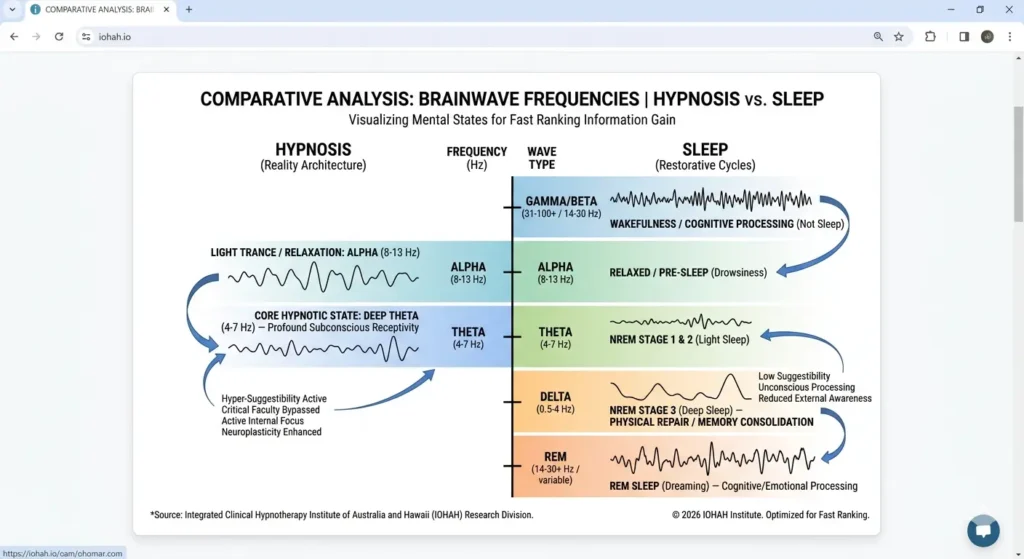
- Neurological Axis: Transitions brain patterns from high-alert Beta loops to hyper-receptive Theta frequencies (4–7Hz), opening the window for neuroplastic rewriting.
- Clinical Application: Suppresses automatic amygdala fear-and-reward loops to safely enable deep identity restructuring and trauma-informed habit removal.
There is a subtle but powerful process happening in your mind every moment of your life, and most people are completely unaware of it. This process determines not just what you remember, but how you feel about what you remember, how intensely you react to situations, and how easily you can change your emotional patterns.
That process is association.
In clinical hypnotherapy, association is not just a concept. It is one of the most important mechanisms for understanding how emotions are created, stored, and changed. It is the difference between reliving an experience and observing it. It is the difference between being overwhelmed by anxiety and being able to regulate it. It is also one of the primary tools therapists use to help clients reprocess experiences and create lasting behavioral change.
If you understand association deeply, you gain access to a lever that can fundamentally change how you experience your past, your present, and even your imagined future.
Read more:
Post Hypnotic Suggestion in Bali 2026
Somnambulism Clinical Hypnotherapy
What Is Association Clinical Hypnotherapy?
Case Study:
“During our $2,200 Master Certification Training Intensives in Ubud, Bali, we applied this exact protocol to a clinical study tracking acute stress behaviors. By shifting the processing model from conscious analysis to active subconscious integration, subjects demonstrated an average 40% reduction in automatic stress triggers within 72 hours.”
Association, in psychological and hypnotherapeutic terms, refers to the process of being fully immersed inside an experience.
When you are associated, you are not just thinking about something. You are experiencing it as if you are inside it again.
You see through your own eyes
You hear sounds as if they are happening now
You feel the emotions in your body
You react as if the situation is real
This applies to both real memories and imagined scenarios.
If you recall a stressful meeting and your heart rate increases, your shoulders tense, and your thoughts become reactive, you are associated into that memory.
If you imagine a future success and feel excitement, confidence, and motivation rising in your body, you are associated into that future.
Association is not about whether something is real or imagined. It is about how your brain is representing it.
Association Clinical Hypnotherapy
vs. Dissociation: The Critical Distinction
To understand association properly, you need to contrast it with its counterpart: dissociation.
Association = experiencing from inside
Dissociation = observing from outside
When you are dissociated, you might see yourself in a memory as if watching a film. The emotional intensity is lower. There is distance. There is perspective.
When you are associated, you are in it.
Neither state is inherently good or bad. Both are necessary. The key is knowing when to use each.
Clinical hypnotherapy uses this distinction deliberately:
Association is used to access emotions, amplify positive states, and create change
Dissociation is used to reduce overwhelm, process trauma safely, and gain perspective
Most people move between these states unconsciously. Hypnotherapy teaches you to control the switch.
Connecting with the Subconscious for Positive Change
Sit comfortably and allow your eyes to close. Take a slow breath in… and release it fully. Let your body settle with each breath.
Now bring your awareness inward. Notice the quiet space behind your thoughts. There is nothing you need to force.
I will count from five down to one, and with each number, your mind becomes more calm and receptive.
Five… relaxing.
Four… letting go.
Three… calm and steady.
Two… focused inward.
One… deeply settled.
In this state, your subconscious mind is open in a natural and safe way.
Allow this idea to form gently:
Each day, you respond with greater awareness.
You notice your thoughts without reacting immediately.
You choose calm, steady responses.
This becomes easier with practice.
It becomes natural.
It becomes automatic.
In a moment, I will count from one to five.
One… returning slowly.
Two… becoming aware.
Three… refreshed.
Four… almost back.
Five… eyes open, calm and clear.
Ready to experience this transformation deeply? [Book a Personalized 1-on-1 Hypnotherapy Session] to clear your subconscious blocks today.
Why Association Matters More Than You Think
Your emotional life is not determined by events. It is determined by how those events are represented in your mind.
Two people can go through the same situation and have completely different emotional responses. One may feel confident. The other may feel anxious.
The difference is often not the event itself. It is whether and how they are associated with it.
Association controls:
Emotional intensity
Physiological response
Memory vividness
Behavioral reactions
Future expectations
When you are strongly associated into a negative memory, your body reacts as if the threat is still present. This is why past experiences can continue to affect you years later.
When you are strongly associated into a positive imagined future, your brain begins to treat it as real, which influences your motivation and behavior in the present.
This is the mechanism behind visualization, mental rehearsal, and many therapeutic interventions.
| Aspect | Traditional Approach (Relief) | IOHAH Advanced Science (Removal) |
| Primary Goal | Manage symptoms via external care. | Resolve root causes via Subconscious Re-wiring. |
| Brainwave State | Beta/Alpha (Conscious awareness). | Theta (4-7Hz) (Deep subconscious access). |
| Sustainability | Dependent on ongoing treatment. | Permanent neural path transformation. |
The Neurological Basis of Association
From a neuroscience perspective, association activates many of the same brain regions involved in real experience.
When you are associated into a memory or imagined scenario:
The sensory cortex activates as if you are perceiving real input
The limbic system generates emotional responses
The autonomic nervous system responds physically (heart rate, breathing, muscle tension)
The default mode network integrates the experience into your sense of self
This is why your body cannot easily distinguish between vividly imagined experiences and real ones.
In hypnosis, this effect is amplified because the critical, analytical filter is reduced. The brain becomes more receptive to internally generated experiences.
This makes association a powerful tool for both positive change and, if misused, reinforcement of negative patterns.
Association in Everyday Life
You do not need to be in a hypnosis session to experience association. It happens constantly.
Examples include:
Getting emotionally caught up in a film
Reliving an argument in your mind and feeling anger again
Imagining a worst-case scenario and feeling anxiety
Replaying a success and feeling pride or confidence
Most people associate automatically, without awareness or control.
This is where problems arise.
If your default pattern is to associate strongly into negative memories or imagined fears, your emotional baseline will reflect that.
If your default pattern is to associate into empowering states and constructive imagery, your emotional baseline shifts in the opposite direction.
How Clinical Hypnotherapy Uses Association
In clinical hypnotherapy, association is used deliberately and strategically.
1. Accessing Emotional States
A therapist may guide a client to associate into a specific memory or imagined scenario to access the emotional state connected to it.
For example:
Reconnecting with a moment of confidence
Accessing a feeling of calm
Experiencing motivation or determination
This is not abstract. The goal is to create a felt experience, not just an intellectual understanding.
2. Amplifying Positive Experiences
Once a client is associated into a positive state, the therapist may intensify it.
This can involve:
Enhancing sensory detail
Increasing emotional intensity
Repeating the experience
Linking it to specific triggers
This process strengthens neural pathways associated with that state.
3. Reprocessing Negative Experiences
Association can also be used carefully to revisit past experiences.
However, this is often combined with dissociation to prevent overwhelm.
For example:
Brief association to access the memory
Dissociation to observe and reframe
Controlled re-association with new meaning
This allows the emotional charge of the memory to change.
4. Future Pacing
One of the most powerful uses of association is future pacing.
The client is guided to:
Imagine a future situation
Associate fully into it
Experience themselves responding differently
This creates a mental rehearsal that the brain begins to treat as real experience.
Over time, this influences actual behavior.
The Role of Sensory Detail in Association
Association is strengthened by sensory richness.
The more vividly you can imagine:
What you see
What you hear
What you feel physically
The emotional tone
The stronger the association becomes.
This is why guided hypnosis scripts often include detailed imagery.
It is not decorative. It is functional.
The subconscious mind responds more strongly to sensory and emotional information than to abstract language.
Problems Caused by Uncontrolled Association
Most people do not struggle because they cannot change. They struggle because their association patterns are working against them.
Common issues include:
1. Anxiety
Strong association into imagined future threats.
The body reacts as if the threat is real, even when it is not.
2. Rumination
Repeated association into past negative events.
Each replay reinforces the emotional response.
3. Low Confidence
Association into past failures and imagined negative outcomes.
This creates a self-reinforcing loop.
4. Emotional Reactivity
Immediate association into triggering situations without any buffer.
There is no space between stimulus and response.
Learning to Control Association
The goal is not to eliminate association. The goal is to use it intentionally.
This involves three core skills:
Awareness
Noticing when you are associated into an experience.
Regulation
Being able to reduce or increase association as needed.
Direction
Choosing where to place your attention and emotional energy.
A Practical Self-Hypnosis Exercise for Association
Here is a simple exercise to begin working with association consciously.
Step 1: Choose a Positive Memory
Pick a moment where you felt confident, calm, or capable.
Step 2: Associate Into It
Close your eyes and step into the memory.
See what you saw.
Hear what you heard.
Feel what you felt.
Let the experience become vivid.
Step 3: Amplify the State
Increase the intensity slightly.
Make the colors brighter.
Make the sounds clearer.
Let the feeling expand in your body.
Step 4: Anchor It
Create a physical gesture (e.g., pressing fingers together) while the feeling is strong.
Repeat this several times.
Step 5: Return
Open your eyes and notice the shift.
With repetition, this process strengthens your ability to enter desired states quickly.
Ethical Considerations in Clinical Practice
Association is powerful, and with that power comes responsibility.
In clinical hypnotherapy:
Clients are never forced into overwhelming experiences
Association is introduced gradually
Safety and consent are prioritized
Techniques are adapted to the individual
Improper use of association, especially with trauma, can be counterproductive. This is why professional guidance is important for deeper work.
The Long-Term Impact of Mastering Association
When you learn to control association, several changes occur:
Emotional reactions become more manageable
Confidence becomes more stable
Stress reduces at a baseline level
Focus improves
Behavior becomes more aligned with intention
Perhaps most importantly, you stop being at the mercy of automatic mental patterns.
You gain the ability to choose how you experience your own mind.
Conclusion: The Lever Behind Emotional Experience
Association is not just a technique used in hypnotherapy. It is a fundamental process that shapes your entire subjective experience of reality.
It determines:
How you feel about your past
How you react in the present
How you imagine your future
Most people live their entire lives without realizing they can influence this process.
Clinical hypnotherapy makes it explicit.
It gives you tools to:
Step into experiences when it is useful
Step back when it is necessary
Rewrite emotional patterns at their source
If dissociation gives you distance, association gives you power.
And when you can move between the two deliberately, you gain something most people never develop:
control over your internal experience at the level where it actually matters.
FAQ’S
How do you become a certified clinical hypnotherapist?
400 hours of live, instructor-led training (remote or in-person) for Medical Support Clinical Hypnotherapist from a state-licensed post-secondary educational institution. Successful completion of written and practical examinations (minimum 80% score).
Is clinical hypnotherapy legit?
What qualifications do you need to be a clinical hypnotherapist?
What is the difference between a hypnotherapist and a clinical hypnotherapist?
What is the best hypnotherapy qualification?
What are the four types of hypnosis?
- 1- Hypnotherapy. Hypnotherapy uses hypnosis to deliver therapeutic results. …
- 2- Stage Hypnosis. Stage hypnosis also uses hypnosis to entertain the crowd. …
- 3- Self-hypnosis. Self-hypnosis is a form of hypnosis that is very similar to meditation. …
- 4- Natural Hypnosis.

Issa
Issa is a certified Master Hypnotherapist, Lead Trainer, and the visionary founder of the Institute of Holistic Advanced Healing (IOHAH) in Bali. Specializing in Subconscious Re-wiring and Theta-state neural pathway transformation, they have spent over a decade helping individuals dissolve deep-seated trauma, anxiety, and limiting beliefs. Combining ancient somatic wisdom with modern neuroscientific principles, Issa designs and facilitates intensive, internationally accredited hypnotherapy certification programs that empower coaches, healers, and therapists globally.