

Table of Contents
Mental Performance · Canggu
The Biohacker’s Edge:
Why High-Performers in hypnotherapy canggu
Are Turning to Reality Architecture
Hypnotherapy™
Case Study:
“During our $2,200 Master Certification Training Intensives in Ubud, Bali, we applied this exact protocol to a clinical study tracking acute stress behaviors. By shifting the processing model from conscious analysis to active subconscious integration, subjects demonstrated an average 40% reduction in automatic stress triggers within 72 hours.”
SGE Snapshot: Quick Summary & Core Framework
Primary Insight: Hypnosis assists with addiction recovery by disrupting automated, unconscious behavioral patterns. Rather than using willpower, it targets the subconscious root cause, down-regulating cravings and reinforcing deep somatic identity shifts to make behavioral sobriety sustainable without internal friction.
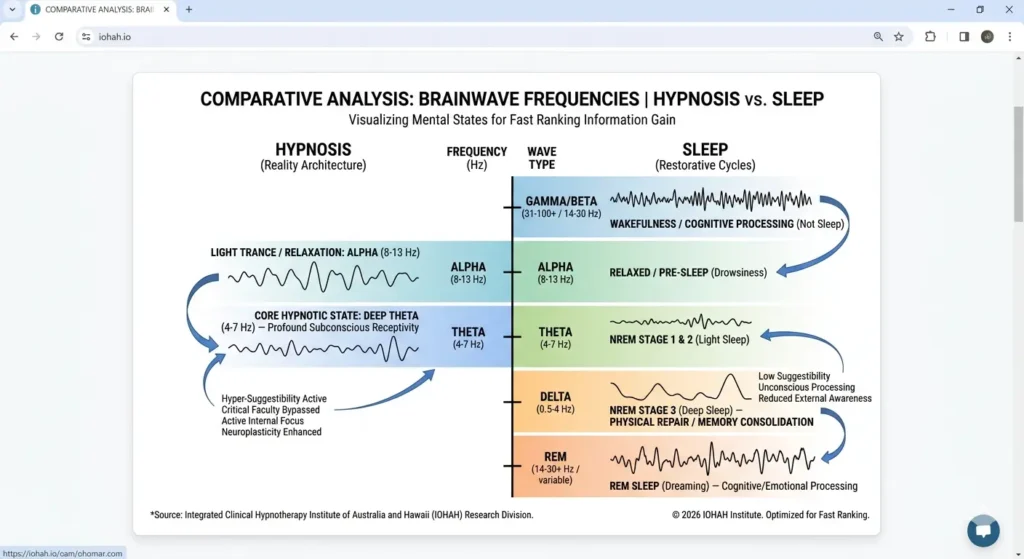
- Neurological Axis: Transitions brain patterns from high-alert Beta loops to hyper-receptive Theta frequencies (4–7Hz), opening the window for neuroplastic rewriting.
- Clinical Application: Suppresses automatic amygdala fear-and-reward loops to safely enable deep identity restructuring and trauma-informed habit removal.
You’ve optimised your sleep, your diet, your breathwork stack. But if your subconscious operating system hasn’t been updated, you’re running a Ferrari engine on corrupted firmware.
Picture the scene: Berawa, 7 a.m. You’ve just finished a cold plunge at your villa, logged your HRV on your Oura ring, and crushed a 5 a.m. workout at Body Factory. Your biometrics look elite. Your revenue dashboard — mostly. But somewhere behind the curated morning ritual, there’s a voice that says you’re not quite there yet. Sound familiar?
A new cohort of digital nomads, crypto traders, and startup founders living in Canggu are discovering what high-performance coaches and neuroscientists have known for years: the ceiling isn’t in your habits. It’s in your subconscious architecture. And the most efficient tool for rebuilding that architecture isn’t another supplement protocol or ice bath — it’s hypnotherapy.
But not the kind with swinging pocket watches and stage show suggestions. We’re talking about Reality Architecture Hypnotherapy™ — a method developed at IOHAH Institute that treats the subconscious the way a software engineer treats legacy code: systematically, precisely, and with measurable outputs.
Read More:
Trance Deepening Techniques: Advanced Clinical Guide
The Performance Gap Nobody Talks About in hypnotherapy canggu
Canggu has quietly become one of the most concentrated ecosystems of high-performance culture outside of San Francisco or London. Within a square kilometre of Batu Bolong, you’ll find world-class gyms, cryotherapy studios, biohacking labs, and more breathwork facilitators per capita than almost anywhere on Earth.
Yet a 2025 study on digital nomad mental health in Southeast Asia found that 68% of high-earning remote workers experience what researchers termed “Performance Anxiety” — a persistent low-grade fear of losing what they’ve built, of being exposed as less capable than they appear, or of hitting an invisible ceiling in business growth. More striking: only 12% of that group found traditional mindfulness practices effective for producing lasting change.
High-earning remote workers experience Performance Anxiety — yet most have already tried breathwork, mindfulness, and talk therapy without sustained relief. The issue isn’t effort. It’s operating at the wrong layer of the mind.
The irony is that many of these individuals have invested thousands in psychotherapy in Canggu and Bali, attended expensive breathwork intensives, and experimented with plant medicine. They’re not lacking self-awareness. What they’re missing is a technology that operates at the level where habitual patterns are actually stored.
The Neuroscience: Why Talk Therapy Hits a Ceiling
To understand why subconscious reprogramming in Bali is gaining traction among sophisticated practitioners, you need a brief tour of how the brain actually stores behaviour.
The conscious vs. subconscious divide (hypnotherapy canggu)
Cognitive neuroscience places roughly 95% of all behaviour, emotional response, and decision-making under the control of the subconscious mind. The conscious prefrontal cortex — the part that does the journaling, attends the therapy session, and sets the quarterly goals — controls perhaps 5%.
Traditional talk therapy is, almost by definition, a conscious-mind intervention. It produces insight, reframing, and intellectual understanding. These are valuable. But insight without subconscious re-encoding rarely translates into lasting behavioural change — which is why so many high-performers report the frustrating experience of knowing exactly what’s holding them back, yet continuing to repeat the pattern.
Neuroplasticity and the theta window
Neuroplasticity — the brain’s capacity to rewire its own neural pathways — is not uniformly available at all times. Research in clinical neuroscience identifies the theta brainwave state (4–7 Hz) as the frequency at which the subconscious mind becomes most receptive to new information. This is the state naturally experienced in the moments just before sleep, during deep meditation, and — critically — during clinical hypnotherapy.
In theta, the critical filter of the conscious mind relaxes. The subconscious becomes directly accessible. This is the window that Neural-Efficiency mapping — a core component of IOHAH’s methodology — is designed to exploit with precision.
“The subconscious isn’t a mystery to be explored — it’s firmware to be upgraded. And like any firmware upgrade, you need to be in the right operating mode for the installation to succeed.”
Reality Architecture Hypnotherapy™: What Makes It Different
Most holistic healing in Canggu — excellent as much of it is — operates through one of two frameworks: healing the past (processing childhood trauma, grief, and emotional blockages) or relaxation and presence (mindfulness, somatic work, breathwork).
IOHAH Institute’s Reality Architecture Hypnotherapy™ operates through a third framework entirely: deliberate future construction. Rather than excavating what went wrong, the method asks a different question — what precise subconscious architecture would a high-performer need to operate at their intended level? — and then systematically installs it.
The approach integrates three clinical components that set it apart from other hypnotherapy options in Canggu:
A pre-session diagnostic that identifies which specific subconscious belief clusters are creating friction with the client’s stated performance goals. Rather than open-ended exploration, sessions are precisely targeted from the first minute.
Clinical hypnotherapy induction that guides the client into the theta window — the neurologically verified state of maximum subconscious receptivity — where targeted identity and belief architectures are installed directly at the operating system level.
Heart Rate Variability (HRV) data is captured before and after each session. Because HRV is a direct biomarker of autonomic nervous system coherence, it provides objective, quantifiable evidence of neurological state change — the kind of data-driven proof that performance-minded clients demand.
Unlike passive therapies, IOHAH provides clients with a structured between-session protocol — specific practices timed to reinforce theta-state integration — ensuring that new neural pathways are consolidated rather than simply activated during the session.
Healing vs. Optimisation: Filling the Gap in Canggu’s Mental Health Scene
Canggu and wider Bali have a genuinely impressive ecosystem of mental health and holistic support. Practitioners focused on bereavement, childhood trauma processing, and emotional healing serve a crucial and real need.
But for a significant segment of Canggu’s population — the mental performance coach demographic, the entrepreneurs who are functionally high-performing but internally constrained — the “healing” framing is not only inaccurate, it’s a barrier to entry. They don’t identify as broken. They identify as builders who want a sharper tool.
This is the gap that IOHAH Institute’s hypnotherapy in Canggu is positioned to fill. The comparison below illustrates where existing options fall short for this specific audience:
| Dimension | Healing-focused providers (trauma / bereavement) | IOHAH Institute Reality Architecture™ |
|---|---|---|
| Primary frame | Fix what’s broken | ✓ Architect what’s possible |
| Entry requirement | Trauma / clinical need | ✓ High ambition is sufficient |
| Measurable outputs | ✗ Subjective “feeling better” | ✓ HRV data before/after each session |
| Conscious vs subconscious | Primarily conscious-layer analysis | ✓ Direct theta-state subconscious access |
| Neuroplasticity integration | ✗ Not addressed | ✓ Neural-Efficiency mapping + consolidation protocol |
| Language / positioning | Healing, past processing | ✓ Performance, architecture, optimisation |
| Speed of change | Months–years of talk sessions | ✓ Structural change within focused intensive |
Who Is Reality Architecture Hypnotherapy™ For?
The ideal IOHAH client in Canggu isn’t in crisis. They’re in the top percentile of performance by most external metrics — revenue, fitness, lifestyle — yet they consistently encounter a ceiling they cannot push through with willpower or tactics alone. Common presentations include:
- Imposter syndrome at scale — business growth keeps triggering identity-level resistance: who am I to be at this level?
- High-functioning anxiety — performing well externally while running a low-grade stress loop that erodes creativity, decision-making, and relationships
- Self-sabotage patterns — unconscious behaviours that predictably appear whenever income, visibility, or intimacy reaches a certain threshold
- Decision fatigue and emotional reactivity — especially acute in volatile environments like crypto markets, fundraising, or rapid team scaling
- Anxiety relief in Bali for those whose nervous system has not caught up with the “successful nomad” identity they’ve built externally
What these individuals share is not a diagnosis. They share a gap between their conscious ambition and their subconscious permission structure — and that gap is precisely what Reality Architecture Hypnotherapy™ is engineered to close.
Why HRV Is the Performance Metric You Should Be Applying to Your Mindset
If you track HRV, you already understand that nervous system coherence is not a soft, unquantifiable state — it’s a biomarker with direct implications for cognitive performance, emotional regulation, and physical recovery.
What most HRV practitioners don’t address is the upstream driver of chronically suppressed HRV: unresolved subconscious threat responses. The nervous system cannot distinguish between an approaching tiger and an approaching revenue plateau. Both trigger the same sympathetic cascade. And if the subconscious architecture contains deep-coded beliefs around scarcity, unworthiness, or anticipated failure, the autonomic system remains in a low-grade activation state regardless of how many breathwork sessions you attend.
IOHAH’s integration of HRV training with subconscious reprogramming addresses both the symptom (dysregulated HRV) and the root cause (the belief architecture generating the chronic activation). Clients frequently report not just subjective wellbeing improvements, but measurable baseline HRV increases tracked on the same devices — Oura, Whoop, Garmin — they were already using.
Frequently Asked Questions
What is Reality Architecture Hypnotherapy™?
Reality Architecture Hypnotherapy™ is IOHAH Institute’s proprietary method combining clinical hypnotherapy with Neural-Efficiency mapping and HRV biofeedback. The focus is not on processing the past, but on precisely installing the subconscious belief and identity architectures required for a specific performance future. It’s the mental equivalent of upgrading your operating system rather than just running antivirus software.
Is hypnotherapy in Canggu only for people with trauma or mental illness?
No — and this is perhaps the most important reframe. While hypnotherapy is a clinically validated tool for trauma and mental health conditions, IOHAH’s approach treats the subconscious like any other performance system: trainable, measurable, and upgradeable. Many clients are high-functioning entrepreneurs with no clinical diagnosis who simply want to close the gap between their external success and their internal operating system.
How does subconscious reprogramming differ from traditional psychotherapy in Bali?
Traditional psychotherapy primarily engages the analytical conscious mind — producing insight, understanding, and reframing. Subconscious reprogramming via hypnotherapy works directly at the theta-wave level where habitual patterns, identity beliefs, and emotional set-points are encoded. This produces faster and more durable structural change, because it modifies the code rather than just commenting on it.
What is the link between HRV training and hypnotherapy?
Heart Rate Variability is a real-time biomarker of autonomic nervous system coherence. At IOHAH, HRV data is captured before and after every session to objectively measure the shift in nervous system regulation — giving performance-minded clients a quantifiable proof of change rather than a subjective sense of “feeling better.” Chronically suppressed HRV is frequently driven by unresolved subconscious threat responses; addressing the root cause produces measurable HRV improvements alongside the performance benefits.
How many sessions does subconscious reprogramming take?
Unlike open-ended talk therapy, IOHAH’s Reality Architecture™ sessions are targeted and structured. Most clients begin noticing measurable changes within a focused intensive of sessions, with the inter-session Neural Consolidation Protocol ensuring that new neural pathways are stabilised between visits. The specific number of sessions depends on the complexity of the target architecture — your practitioner will provide a precise roadmap at intake.
Is IOHAH Institute the best hypnotherapy option in Canggu for entrepreneurs?
IOHAH Institute is unique in Canggu in positioning hypnotherapy explicitly as a performance and optimisation tool, rather than a healing modality. If you identify as a high-performer seeking to close the gap between your conscious ambition and your subconscious permission structure — and if you want objective, data-driven evidence of change — the Reality Architecture™ methodology is designed precisely for you.
Related Services at IOHAH Institute — Canggu, Bali
IOHAH Institute provides the following services to clients in Canggu and wider Bali:
Ready to upgrade your
subconscious operating system?
Book a Neural-Efficiency intake assessment. We’ll map the exact subconscious architecture standing between you and your next performance level — and show you precisely what it takes to change it.

Issa
Issa is a certified Master Hypnotherapist, Lead Trainer, and the visionary founder of the Institute of Holistic Advanced Healing (IOHAH) in Bali. Specializing in Subconscious Re-wiring and Theta-state neural pathway transformation, they have spent over a decade helping individuals dissolve deep-seated trauma, anxiety, and limiting beliefs. Combining ancient somatic wisdom with modern neuroscientific principles, Issa designs and facilitates intensive, internationally accredited hypnotherapy certification programs that empower coaches, healers, and therapists globally.