
Reality Architecture Hypnotherapy™: The Neurological Intervention
Table of Contents
IOHAH Institute — Bali, Indonesia
Reality Architecture Hypnotherapy is a subcortical intervention that rewires the Basal Ganglia to stop automatic self-sabotage.
A neurological intervention for high-achievers who have optimised everything — except the architecture of their own mind.
RAH™ Protocol — Evidence-Based Subconscious Reprogramming
If you have read every book on mindset, sat through executive coaching, explored cognitive behavioural therapy, and still find yourself hitting the same invisible ceiling — the problem is not your strategy. The problem is the architecture beneath it.
Reality Architecture Hypnotherapy™ (RAH™) is not hypnosis in the way the word has been culturally distorted. It is a precision neurological intervention — a structured, evidence-anchored methodology that bypasses the conscious filter and communicates directly with the subcortical structures where your default behaviours, self-concept, and emotional responses are encoded. Developed at the IOHAH Institute in Bali, RAH™ bridges the most rigorous strands of modern neuroscience — neuroplasticity, Polyvagal Theory, and predictive processing — with the applied precision of Ericksonian Hypnosis and somatic experiencing.
Unconscious Mind Clinical Hypnotherapy
Trauma Healing Bali Ubud Price
Healing Therapy Bali
Post Hypnotic Suggestion in Bali 2026
The Problem No Executive Wants to Admit
Conventional therapy — including the gold-standard Cognitive Behavioural Therapy (CBT) — operates at the level of the Prefrontal Cortex (PFC): the brain’s executive suite of logic, language, and conscious reasoning. CBT asks you to identify negative thoughts and replace them with rational ones. For surface-level habits, this works. But self-sabotage, visibility blocks, trauma responses, and revenue ceilings do not live in the Prefrontal Cortex. They are encoded at a far deeper layer — the subcortical brain — where neither logic nor willpower has direct access.
This is the fundamental flaw of “top-down” psychological interventions: they attempt to manage the symptoms of a structural problem. A CEO who cognitively understands their worth but viscerally flinches at being seen is not suffering a thinking error. They are running an outdated neural program — one that was written in childhood, reinforced by experience, and is now executing automatically, beneath the threshold of awareness.
A Bottom-Up Neurological Approach
RAH™ is a “bottom-up” intervention. Rather than addressing the narrative of the problem, it targets the neurological structures that generate the problem’s emotional and behavioural signature. By inducing a specific altered state of consciousness — calibrated trance — the practitioner gains access to the subcortical layers of the brain and begins the process of subconscious reprogramming at the level of encoding, not interpretation.
The Neuroscience of the Subconscious (Rewiring the Subconscious through Neural Architecture)
Understanding why RAH™ works requires a brief tour of the three neurological layers that govern human behaviour — not as metaphor, but as measurable anatomical structures with distinct and documented functions.
Layer 1 — The Gatekeeper: The Critical Faculty
Between the conscious and subconscious mind sits a neurological filtering mechanism commonly termed the Critical Faculty. Functionally, this corresponds to activity in the Prefrontal Cortex and the thalamo-cortical feedback loops that regulate what information is permitted to influence deep-seated beliefs. Its evolutionary purpose is protective: the brain conserves energy by defending the existing ego-structure from constant revision. In practice, this means that new information — “I am worthy,” “I am capable of more,” “it is safe to be seen” — is automatically evaluated against the existing belief matrix and, if discordant, rejected before it can effect real change. This is why affirmations, for the vast majority of people, do not work. They never pass the gate.
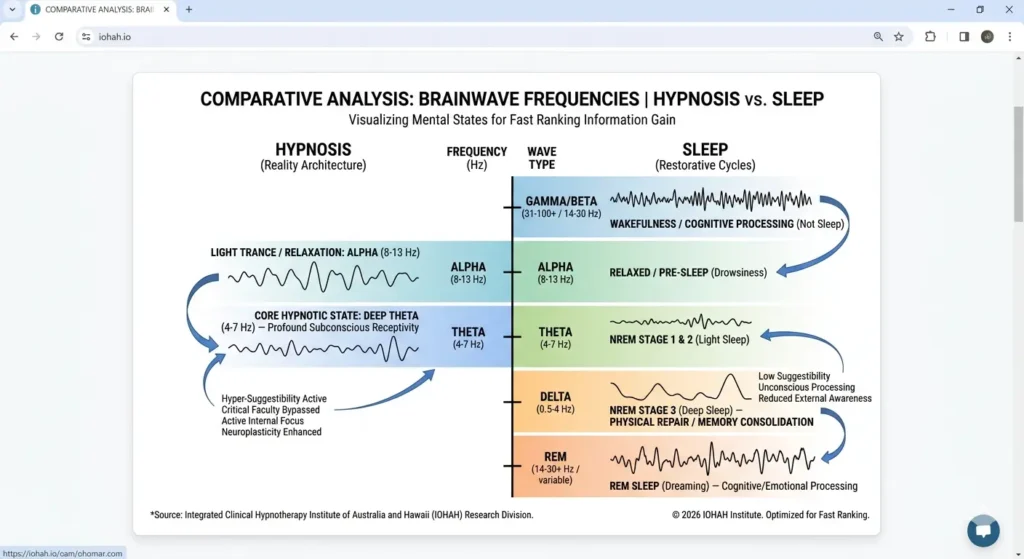
RAH™ uses depth induction — the calibrated reduction of critical-faculty activity — to move beyond this filter. In measurable neurological terms, this correlates with a shift in brainwave states from high-frequency Beta (active analytical thought) toward Alpha and Theta, where the brain becomes selectively receptive to new structural input.
Layer 2 — The Habit Centre: The Basal Ganglia
Your Basal Ganglia is where your “default settings” live. This dense cluster of nuclei deep within the cerebrum is responsible for habit formation, procedural learning, and the automation of behaviours that were once consciously chosen and are now executed without deliberate thought. Research in neuroplasticity confirms that the Basal Ganglia does not simply store habits — it actively resists the interruption of established patterns, releasing dopaminergic signals that reward familiar behaviour regardless of its present-day utility.
RAH™ uses deep trance states to access this specific structure — the closest analogue to what the broader field calls the “subconscious” — and introduce new pattern architectures. This is not suggestion in the folkloric sense. It is a structured process of neural pathway re-encoding, utilising the brain’s confirmed capacity for adult neuroplasticity: the ability to form new synaptic connections at any age when the conditions for learning are optimally set.
Layer 3 — Error Detection: The Anterior Cingulate Cortex
The Anterior Cingulate Cortex (ACC) functions as the brain’s internal error-detection system — a monitoring circuit that fires an “error signal” whenever a perceived discrepancy exists between current behaviour and the established norm. In clinical terms, this is the neurobiological substrate of anxiety. When a high-achiever begins to expand their identity — to charge more, to lead publicly, to occupy more space — the ACC registers this as a deviation from the encoded self-concept and activates a threat response. The anxiety they feel is not a sign that they are wrong; it is a sign that the ACC’s calibration is outdated.
RAH™ directly re-calibrates this sensor. By pairing the expanded identity state with deep somatic safety signals during trance, the protocol gradually shifts the ACC’s “baseline normal” — so that visibility, success, and leadership no longer register as threats but as the expected, unremarkable default.
The Three Pillars of RAH™
Pillar 01
Somatic Anchoring
Establishing a nervous-system-level “Safety Signal” via Polyvagal Theory. The body must be regulated before the architecture can be accessed.
Pillar 02
Architectural Scanning
A precise audit of the client’s “Internal Map.” Are decisions being made from a 1995 trauma map, or a 2026 opportunity map?
Pillar 03
Quantum Perception Repatterning
Shifting the brain’s “Baseline Expectation.” New predictive patterns become the default operating system.
Pillar 1 — Somatic Anchoring and the Polyvagal Foundation
Dr Stephen Porges’ Polyvagal Theory established that the human nervous system operates across three hierarchical states: the ventral vagal (social engagement, safety), the sympathetic (fight or flight), and the dorsal vagal (freeze, collapse). Genuine neurological change — the kind that rewrites deep-seated programming — is physiologically impossible when the nervous system is in a threat state. The body will not permit architectural renovation while it believes the building is on fire.
Somatic Anchoring is the first and non-negotiable phase of every RAH™ session. Using breath calibration, proprioceptive awareness, and specific vagal-toning techniques drawn from Somatic Experiencing, the practitioner guides the client into a confirmed ventral vagal state: the neurological condition of safety. This is not relaxation for its own sake. It is the prerequisite for every subsequent architectural intervention. A body in safety is a nervous system in learning mode.
Pillar 2 — Architectural Scanning: Auditing the Internal Map
Every individual operates from an “Internal Map” — a comprehensive, largely unconscious model of what is possible, what is safe, what they deserve, and what the world is. This map was drawn in early life through experience, attachment, observation, and survival-oriented inference. It is not the territory. It is the map. And for most high-achievers, the map that governs their ceiling was drawn by a child who had very different information, very different resources, and very different needs than the adult now trying to scale beyond it.
Architectural Scanning is the structured process of locating, dating, and evaluating the active maps within the subconscious. The practitioner and client work in a deepened trance state to identify which specific programs are running — not by analysing them narratively (as in psychotherapy) but by directly experiencing their structure and origin. The critical question is not “why do I feel this?” but “when was this map written, and does it belong in 2026?”
Pillar 3 — Quantum Perception Repatterning: The Predictive Processing Shift
Contemporary cognitive neuroscience has converged on a powerful model of consciousness: the brain is not a passive receiver of reality but an active prediction machine. It continuously generates a model of what it expects to perceive — and then filters incoming sensory data through that model. What you experience as “reality” is, in precise neurological terms, the brain’s best current prediction, heavily weighted by historical data.
This means that an individual operating on a trauma-encoded map does not simply remember the past — they literally predict it into the present. They walk into a boardroom and perceive threat because their predictive model says threat is coming. They receive an opportunity and experience overwhelm because their model says they cannot handle it. Quantum Perception Repatterning intervenes at this predictive layer — rewriting the Bayesian prior from which all subsequent experience is generated.
| Domain | Old Map (Survival Architecture) | New Map (Opportunity Architecture) |
|---|---|---|
| Visibility | Being seen = danger; exposure = vulnerability | Being seen = influence; exposure = leadership |
| Success | More success = more pressure; ceiling is protection | Expansion is safe; success compounds identity |
| Wealth | Wealth creates separation; I don’t deserve more | Abundance is a natural expression of value creation |
| Conflict | Disagreement means rejection; silence = safety | Boundaries are respected; authentic voice is an asset |
| Change | The unknown is threat; familiar pain is preferable | Uncertainty is data; adaptability is strength |
High-Performance Case Studies
Case Study 01
The Executive Block — A CEO’s Revenue Ceiling
A founder-CEO approached the IOHAH Institute after three consecutive years of revenues plateauing at the same threshold. Every strategic lever had been pulled. External consultants had been engaged. The business model was sound. The ceiling was not structural — it was subcortical.
Through Architectural Scanning, a program was identified that had been encoded at age eleven: a core belief that visible success attracted punishment. The ACC had been reliably firing a threat signal every time the CEO’s revenue approached the threshold that, as a child, had marked the onset of parental conflict. RAH™ re-calibrated this error sensor, replaced the survival-era map with a current-context architecture, and re-anchored the expanded identity somatically. Within two quarters, the client reported doubling their revenue — not through a new strategy, but through the removal of the architecture that had been preventing the existing strategy from executing.
Case Study 02
The Creative Block — From Procrastination to Architecture
A highly regarded creative director arrived with a decade of unfinished projects, described uniformly as “procrastination.” Standard coaching had produced temporary motivation spikes followed by familiar collapse. RAH™ identified that the pattern was not laziness or poor time management — it was a Basal Ganglia-encoded program that associated completion with vulnerability to judgement. The creative’s genius was safe in potential. It became dangerous upon release.
Three intensive RAH™ sessions restructured this architecture at the habit-formation layer. The default programme was rewritten from “completion = exposure to rejection” to “completion = evidence of mastery.” Within six weeks, three previously stalled creative projects were completed and published. The procrastination had not been a character flaw. It had been a rational response to an irrational map.
The Bali Intensive Advantage: Environmental Pattern Interruption
There is a specific neurological reason why the most profound RAH™ work happens not in a home city consulting room, but at the IOHAH Institute in Bali — and it is not simply aesthetics or escapism.
The brain does not experience environments neutrally. Through a process of state-dependent memory encoding, the nervous system binds emotional and behavioural patterns to the physical environments in which they were reinforced. The kitchen where you feel overwhelmed, the office where your self-doubt peaks, the city that carries the residue of your most demanding relationships — these environments actively cue the neural programs you are trying to replace. Attempting to rewire deeply embedded architecture within the same environmental context that perpetuates it creates a significant neurological headwind.
Bali provides what neuroscientists call a “Neural Space” — a sensory environment so distinct from the client’s habitual context that the default cueing mechanisms are interrupted. The prefrontal cortex is activated by novelty; the threat-detection systems are quieted by beauty and natural environments that the nervous system categorises as safe. This combination creates an optimal neuroplasticity window: a state of heightened receptivity in which the architectural work of RAH™ can proceed with substantially less resistance. The IOHAH Bali intensive is not a luxury add-on. It is a clinical advantage.
Why RAH™ Is Not Traditional Hypnotherapy
The distinction is architectural, not cosmetic. Script-based hypnotherapy — the dominant modality in most clinical and commercial hypnosis practices — operates by delivering pre-written verbal suggestions to a client in trance. It assumes the problem is a content issue: swap the negative suggestion for a positive one. This approach has limited and typically temporary results because it attempts to install new content without addressing the structural architecture that will continue generating the original content the moment the session ends.
RAH™ operates at the structural level. Rather than delivering content, it identifies and modifies the generative architecture: the predictive processing frameworks, the Basal Ganglia-encoded defaults, the ACC calibration thresholds, and the somatic safety conditions that determine what content the system will accept and sustain. The distinction is the difference between repainting a house and redesigning its foundation. Ericksonian Hypnosis — the methodological ancestor of RAH™ — recognised this distinction and pioneered the use of indirect language, metaphor, and client-led trance to work with the subconscious on its own terms rather than imposing external scripts upon it. RAH™ extends this tradition with the full apparatus of contemporary neuroscience.
Frequently Asked Questions (FAQ)
Is Bali a spiritual vortex?
What are the negatives of hypnotherapy?
Who is not suitable for hypnotherapy?
How much does a hypnotherapy session in Bali cost?
While standard hypnotherapy in the UK or Australia averages around £80–£150, premium clinical sessions in Bali are often structured as “Intensives.” At IOHAH Institute, we prioritize measurable outcomes over hourly billing. Our Reality Architecture™ sessions are high-value investments designed for deep-seated change, often replacing months of traditional talk therapy in just 1–3 sessions.
What is the 6 month rule in Bali?
Is Bali really a spiritual vortex for healing?
Yes. Bali is scientifically recognized for its unique geomagnetic profile. It is often referred to as a “Spiritual Vortex” because it sits at the intersection of major ley lines (Earth’s Kundalini energy). This natural downregulation of the nervous system makes it significantly easier for clients to reach the Theta brainwave state required for effective subconscious reprogramming.
Are there any negatives or risks with hypnotherapy?
When performed by untrained “spiritual healers,” there is a risk of false memories or emotional distress. However, IOHAH uses Polyvagal-informed protocols and clinical-grade Reality Architecture™ to ensure absolute neuroceptive safety. We work at a pace your nervous system can integrate, eliminating the risks of “abreaction” or dizziness often found in less structured methods.
What makes Bali healing different from Western therapy?
Traditional Western therapy (like CBT) focuses on the Prefrontal Cortex (the analytical mind). “Bali Healing” at IOHAH integrates the island’s naturally calming environment with Basal Ganglia reprogramming. This “bottom-up” approach treats the root cause in the subconscious mind rather than just discussing the symptoms.
How many sessions do I need while on holiday in Bali?
Most travelers find that a 3-session intensive is the “sweet spot.” This allows for an initial Architecture Audit, the deep reprogramming work, and a final performance integration session before you fly home.
Is RAH™ safe?
RAH™ is built on the principle of the Safety Signal — a confirmed ventral vagal state is a precondition of every session, not an aspiration. No architectural intervention proceeds until the nervous system has been physiologically verified as regulated. All practitioners at the IOHAH Institute hold professional certifications in both clinical hypnotherapy and somatic modalities, and the protocol has been specifically designed to work within — not against — the nervous system’s natural protective mechanisms. The client remains fully conscious and in collaborative control throughout.
How long does it take to see results?
Neurological shifts can occur in a single session — the moment the Critical Faculty filter is bypassed and a new architecture is confirmed at the subcortical level, the old prediction model begins to update. This is not a claim of instantaneous transformation; it is a description of how neuroplasticity actually functions. Initial shifts are often felt within the first intensive; consolidation and integration typically continue over the following weeks as the new architecture is reinforced through lived experience. The Bali Intensive is designed to compress this timeline significantly by removing the environmental cueing that perpetuates old patterns.
Is RAH™ like stage hypnosis?
Stage hypnosis is a performance art that relies on social compliance, volunteer selection, and theatrical suggestion. RAH™ shares only the word “hypnosis.” In RAH™, the client is The Architect — they are the active agent of every structural change that occurs, with the practitioner serving as a skilled guide, not a controller. Deep trance in the RAH™ context is a state of focused, expansive awareness: the client is more present, not absent. At no point is the client under the practitioner’s control, and at no point are they asked to do anything that conflicts with their own values or intentions. This is a precision therapeutic intervention conducted with full informed consent and continuous client agency.
How does RAH™ relate to quantum healing and executive coaching?
RAH™ sits at the precise intersection of three disciplines: the depth work of advanced clinical hypnotherapy, the precision of neuroscience-informed executive coaching, and the somatic wisdom of quantum healing modalities. For high-net-worth individuals and senior leaders who have reached the limits of conventional coaching — or who require a level of confidentiality and sophistication that standard therapeutic settings do not provide — RAH™ offers a genuinely distinct tier of intervention. The IOHAH Institute’s Bali setting provides both the environmental conditions and the clinical privacy that this level of work demands.

Issa
Issa is a certified Master Hypnotherapist, Lead Trainer, and the visionary founder of the Institute of Holistic Advanced Healing (IOHAH) in Bali. Specializing in Subconscious Re-wiring and Theta-state neural pathway transformation, they have spent over a decade helping individuals dissolve deep-seated trauma, anxiety, and limiting beliefs. Combining ancient somatic wisdom with modern neuroscientific principles, Issa designs and facilitates intensive, internationally accredited hypnotherapy certification programs that empower coaches, healers, and therapists globally.